It is important in modern parenting to be truthful but also entertaining as far as bringing up the children is concerned. Sometimes one of these stipulations may be at the expense of the other. This is where the myths and legends are born that stay in the memory of your children forever. They remain fresh and alive because they served to excite, stimulate and to be honest, petrify, young, formative and inquisitive minds at the time.
Even when they reach adulthood, when things gets a bit more serious, this memory resource kicks in and reminds them that ,at heart, they are still children, your children. Their fondest recollections may be based on a complete fabrication of nonsense but that is perfectly fine because they have assimilated all the information themselves and have come to their own reasoned understanding which will serve them well for the rest of their lives.
Take the story told to our three children about the invisible giant who lived in the next street to ours.
He/she/it, not wanting to judge giants on a gender basis, would be sat up on the telephone wires every time we walked to town from our house.
We would gradually pick up speed as we approached the cut through snicket over which the giant had a great vantage point. The children would skulk along, heads down in order to avoid any form of eye contact with the creature. I may have mentioned that people could be turned to stone in such an event. What a ridiculous thing to say to impressionable children. Everyone knows that it is the Gorgons that do that to onlookers. A giant is more inclined to just eat you and grind your bones as a substitute for flour for home baking -possibly a sign of intolerance to wheat products.
Perhaps I should not have provided a running commentary on what the giant was doing as we passed by under his swinging feet but it felt right to keep the children up to date with the behavioural traits of such an uncommon creature for our local area.
The high fencing flanking the snicket, when we eventually reached it, did provide some shelter from the persistent staring and drooling of the grumpy giant and we were glad to duck into the narrow passage after being stuck out in the open of the roadway.
From the relative sanctuary of our refuge we could glance back timidly at the sight of the telephone wire sagging and straining under the great flabby weight of that fearsome and intimidating figure. We always planned to come back by another, much longer but definitely safer route as laden with bulging shopping bags we could be easily picked off one by one.
The giant resided there for many, many years but behaviour and attitude towards us did not improve with familiarity.
As the children grew up and got more independent they did not feel that they wanted to go on the usual trips to the shops with their parents and started to go out with their friends, firstly on their scooters and bikes and then by bus and later by car. The treading of the usual path under the malevolent gaze of the giant was no longer a large part of our lives.
We moved house, a little further away and had no cause to use the snicket as a cut through to town. Many years later I found myself on that street but sadly the giant had upped and left. I conveyed the news to my now older teenage children and we were a bit sad but also optimistic that the giant had moved on to somewhere with a better view than a residential street.
Personally I blamed the telephone company for driving the giant away. I suppose that they have a responsibilty to replace wires where the outer weatherproof cover has separated from the actual cable and hangs down as though under the haunches of a fantastical but clinically obese mythical entity.
Tuesday, 20 October 2015


Monday, 19 October 2015
Whodunnit?
A certain smell, a specific taste, a distinctive sound, the touch of a material;
These all act as triggers to open up the vast bank of memories buried in the human brain hard drive.
To me the distinctive odour of Dettol brings back instantly the recollections of junior school and in particular the wooden recorder musical instruments. These were dipped in the opaque solution of antiseptic after each session in an attempt to kill off the germs from multi-child use. I did suffer from travel sickness when young. This may have been due to the very plasticky interiors of the cars of the 1970's, being squashed on the back seat amongst my four brothers and sisters or as a natural consequence of always scoffing down my sweets and goodies straight away rather than rationing them through the journey.
Various "old wives" remedies and quack practices were tried to combat the otherwise surefire event of my vomiting in a confined space or over my fellow passengers. The favourite, obviously on a low cost option was for me to be sat on a broadsheet newspaper from the onset of a road trip. Whether this actually worked through some freakish alignment of body energy or just psychologically was questionable but either way I ended up with newsprint blackened trousers and ink stained sweat-reddened back of the legs.
The specific taste I soon came to associate with being in the car was that of the medecine I was then required to take to counter nausea and illness. It was disgusting and I invariably threw up within a few minutes of taking it, regardless or not if we had actually started on a trip.
A very distinctive sound that I recall from childhood but came to dread was the "breep-breep" tone of the slimline home telephone. The land line phone was quite futuristic in the 1970's, a cheese wedge shape with lightweight handset and with our version being in a sort of avocado green. Although often announcing something pretty mundane the ring tone could also announce sad news and I clearly remember the anguish and emotional upheaval in the voices of my parents upon hearing about the death of close family and relatives. Although actually a rare occurence any hint of mortality impacted a lot on my young mind. Even now I have a sense of great trepidation when the phone rings. It is a relief, frankly if the voice on the other end of the line is an automated message about PPI or a distant and exotic accent from an overseas call centre.
Touch is also an evocative sense to me. This may be that from a favourite toy, a familiar shape or a textured surface such as my old cuddly blanket. That particular item of fabric survived well into my 20's ending up as a small fragment that I used to clean my bike,
So far I have attributed a trigger effect to four of the human senses.
The fifth, although in no particular order is of course sight.
I may upset quite a few people by saying that an abiding memory is that of feeling very poorly upon any sight whatsoever of the great British actress, Margaret Rutherford.
She is, I acknowledge a national treasure through her cinematic and stage performances but in her role as the amateur sleuth, Miss Marple-a creation of murder mystery writer Agatha Christie I am immediately reminded of faking sickness in order to skive off school.
I was a nervy child and any, even minor incident or upset in school time would start off a phantom stomach ache, imaginary head fever or trumped up dramatic reaction giving the impression that I was close to death. I found that very rapid breathing over, say, five minutes could invoke a dizziness and state of near collapse and that was quite a useful method to arouse concern amongst the teaching staff resulting in a phone call my parents for me to be collected or a ride home in a staff members car.
Margaret Rutherford was always on the television in a black and white film when I was comfortably reclined under an eiderdown in the living room in familiar surroundings. Although ecstatically happy to be at home and before my siblings got back from their schooling the whole process of twagging off did come at a price to my physical and mental state.
Even though some four decades ago I cannot now watch any movies from Margaret Rutherford's illustrious and long serving career which is a massive disservice to the great old lady.
Perhaps one day I might feel able to enjoy such classic films as Murder Most Foul, Blithe Spirit and The Importance of Being Earnest without those otherwise, in the day, useful side effects.
Sunday, 18 October 2015
Roots
Mrs P is a regular client. Over the years she has called upon me to provide advice on various property related matters from buying and selling to disputes over leasehold covenants, building defects, in more recent years following earthquake damage to a ceiling and just last week when a heavy mirror decided to fall off the wall in her flat with no prior warning.
She is a nice senior lady, long time retiree from working in a bank and apart from the usual aches and pains that go with advancing years leads an active life.
On my recent summoning, my last call of that day, Mrs P handed me a very oversized wine glass, almost full to the brim with a rich, pinky, reddish liquid.
Overcoming a squeamishness in case it was a blood sample she wanted me to take to the hospital for her, I then thought about having to decline the offer of alcohol as I was still at work and in the car.
It was beetroot juice.
Apparently she was now drinking significant amounts of it on a daily basis. Fruit juices are perfectly fine but my previous experience of drinks made from vegetables has not been pleasant. Usually an impulse buy, when having been persuaded by clever packaging in the organic aisles of the supermarket, I have been disappointed and disgusted in equal proportion by foul odour emitting liquids of dodgy hue, with unidentified earthy bits in suspension and one hell of an after taste, not to mention discolouration to teeth, tongue and lips.
The Mrs P serving of beetroot was in complete contrast. Cool from the fridge, odourless (the beetroot, not Mrs P), and smooth in texture it was a most surprisingly refreshing treat.
Obviously a big fan of beetroot , Mrs P showed me the carton in which it had been purchased at her local Waitrose.
In pop culture style it was branded "Beet-it" with bright lettering and images and with much of the printed surface promoting the health and related benefits of the stuff. There was some emphasis on the blending in of 10% apple juice in order to counter the usual muddy tints and suggestions in natural, unadulterated beetroot.
My attention was drawn immediately to a warning that consumption can lead to a pinkish tint in urine. I made a short mental note not to panic and call my doctor if that sort of side effect materialised later on that evening. I am at that age when anything out of the ordinary in bodily functions can be a cause for concern indeed.
Beetroot; it is a fascinating root vegetable with a bit of an understated pedigree.
There are references to beet in 800BC with it being grown in that allotment known as the Hanging Gardens of Babylon and also offered to the Greek deities at Delphi. The latin name of Beta Vulgaris, roughly meaning I think in literal translation, rude beet, is not really self promoting compared to more sexily name vegetables such as potato, turnip, swede and carrot.
Grown widely in Europe and Scandinavia it formed a diet staple in pickled form, salads, borsch and accompanying herring dishes. Those who have unwittingly spilt beetroot juice on their clothes will know well of the intensity of staining potential as a direct illustration of the application of the extract in food colouring.
Mrs P had obviously been attracted in her new favourite tipple to the alleged medicinal properties of the stuff. In the early civilisations and Middle Ages beetroot was used to temper blood ailments, digestion problems and as a source of vitamins and minerals (although not known by any name in the pre enlightenment era).
The producers of "Beet-it" do reinforce the health benefits of their juice with references and on-line links to ongoing research by mainly sports scientists.
2014/2015
"Dietary nitrate modulates cerebral blood flow parameters and cognitive performance in humans"
2013
"Effects of nitrate on the power-duration relationship for severe-intensity exercise"
"Beetroot juice can significantly benefit athletic performance at altitude"
"Effects of nitrate supplementation via beetroot juice on contracting rat skeletal muscle microvascular oxygen pressure dynamics"
"Beetroot juice and exercise: pharmacodynamic and dose-response relationships"
2012
"Acute dietary nitrate supplementation improves dry static apnea performance"
"Blood pressure-lowering effects of beetroot juice and novel beetroot enriched bread products in normotensive male subjects"
2011
"Acute dietary nitrate supplementation improves cycling time trial performance"
"A toast to health and performance! Beetroot juice lowers blood pressure and the O2 cost of exercise"
2010
"Dietary nitrate supplementation enhances muscle contractile efficiency during knee-extensor exercise in humans"
2009
"Dietary nitrate supplementation reduces the O2 cost of low-intensity exercise and enhances tolerance to high-intensity exercise in humans"
2008
"Acute blood pressure lowering, vasoprotective, and antiplatelet properties of dietary nitrate via bioconversion to nitrite"
2007
"Effects of dietary nitrate on oxygen cost during exercise"
Impressive list by all accounts.
I am through my second big carton of "Beet-it" since my introduction to it by Mrs P.
I do feel more able to cope with the intensive efforts of road and mountain bike riding which may be an affect of the oxygenisation of my bloodstream. My memory appears sharper, at least to me and not those people....um, err, ooh...oh yes, my wife and son what I live with.
Perhaps, and best of all I can now sprint to the upstairs loo without being out of breath in order to watch with fascination as an almost fluorescent pink stream of urine courses into the bright white ceramic pan.
Saturday, 17 October 2015
Mettle and Steel
I lived from 1971 to 1979 in Brigg, a Lincolnshire town in what is usually described as the North Midlands or just the North East of England.
It was a smallish place with a busy through road, two river crossings and all that I recall by way of industry was a sugar beet processing plant, and a bicycle and marmalade factory- I stress the latter were two separate business operations.
Looking back it was a happy time. We had moved with my father's job and everything was new and fresh.
They were my formative years, I realise that now.
At age 8 there was not too much to worry about giving plenty of time to pursue the most important things such as playing out, riding a bike, exploring the local area and football. My family life was blessed with loving parents and, after the arrival of my youngest brother, Mark in 1975 there were five of us children in total, so quite a houseful.
We were free, with such a stable footing in life to just get on with being children and we made the most of it.
Of course there were a few downsides. School was one of them.
I was a quiet and painfully shy child, heaven knows why what with coming from a large family, and this was a hindrance in my first few years in new academic surroundings. The town Junior School was one of those inter-war built types with a covered verandah walkway with classrooms off. A common accident would be a child walking into an suddenly outward opening. glazed door as a member of staff went for a crafty cigarette in the staff room.
I did participate in most things on offer, in the choir, drama and music groups and I was quite good at running and sports in general. In education I was a bit of a plodder but got through the very devisive bit of social engineering that was the 11-plus examination.
This took me to the Boys Grammar School, founded in the 1600's by a Cromwellian and still steeped in history and tradition including a number of boarding pupils. I think that my year intake were the first not to be required to wear short trousers.
For all the burden of heritage it was a very active establishment in curriculum and extra-curriculum activities including a Scout Troop in which I got to sail, canoe, climb, camp under canvas and legitimately set fire to things. Happy times indeed.
The teaching staff were very much in the Old School style being strict but fair but you could accept and respect them for it. In true Grammar School ethos the emphasis was on preparing its pupils to progress to a University course but the mid to late 1970's, on hindsight, was the beginning of the end for this time served path through life.
Many of my Junior School friends did not pass the 11-Plus exam and so were sent to the new, brash Secondary Modern Co-Ed Comprehensive on the edge of the town. The mother of my best friend really laid into me upon hearing that her son had not got through the selection process and I had. Her sad, anguished and angry outburst had a great impact on my innocent ears and still sits heavily with me now, some four decades later.
I meandered through senior school, not at all sure what I wanted to do by way as a job.
A bit of sound advice and guidance was needed and in the course of a Chemistry lesson, I do not remember the date or time, the teacher set the scene of how our lives might play out.
Brigg was about 9 miles from the nearest large town of Scunthorpe.
Often the brunt of jokes about its spelling such as "who put the c**t in Scunthorpe?" or a perception, typically unfounded, about its inhabitants it was a boom town around one of the largest Steel Works in Europe.
In the 1970's it expanded at a startling rate as the main employer British Steel employed thousands coming from all over the UK. The industry operated using the latest technology and the huge blast furnace buildings sprawled over and dominated the east side of the town. From the hill overlooking the plant you could see right into the fiery heart of the production process.
It was tough and dangerous work but well paid and seen as promising a job for life.
The chemistry teacher, digressing from some experiment or other with lithium, gave us a lot to think about in perhaps for the first time putting our future choices in focus.
I was fifteen and approaching the time to make a decision about staying on at the Grammar for two extra years or leaving to go to a vocational college or to find a job. He said that with plentiful employment at the Steel Works we could all leave school and after an Apprenticeship in the Furnaces, Rolling Mills or support industries would be sitting pretty with money enough to buy a car, a house and settle down as tax paying citizens. In contrast, those thinking about the academic route of two more school years and say, three to four years at University, would not reach the same earning potential for the duration and until then would be living at home with mummy and daddy, relying on lifts and handouts and constituting a drain on the finances of the nation. You could postpone indefinitely any thoughts of home ownership and perhaps, getting a girlfriend.
Confusing times indeed on all fronts. I could have done without additional angst, what with being a pubescent, spotty faced teenager at the time.
The advice and guidance, even so bleakly put, would prove to be a pivotal point for me.
I opted for the academic route but many of my friends went to work for British Steel and thrived in that heavy industry.
I moved away from Brigg with my family in 1979 and inevitably lost touch with my friends in the town.
Scunthorpe established itself as a centre of excellence for Steel putting millions of pounds into the local economy through the pay packets of its workers and those who relied upon the presence of the manufacturing giant for support and ancillary operations from lorry haulage firms to kiosk sandwich makers.
The job for life expectation began to unravel with the short term gains of privatisation from 1988 and changes in global markets for steel, principally the emergence of China as a major producer at much lower unit cost.
It is with great sadness that I heard the news just yesterday of the imminent large scale redundancies at the Scunthorpe Steel Works by its Indian owners, Tata. This brought back to me the emotions aroused by that period in my life when decisions had to be made that would set in motion a new direction and succession of events. It is a fragile existence indeed.
Friday, 16 October 2015
Twinned with Midsomer-unfortunately.
In a small town, circa 4000 population, not much really happens, even on year to year basis.
There is a fairly stable population in terms of numbers apart from minor fluctuations to the positive or negative brought about by natural deaths, marriages and births or in the case of one notable year, a murder.
It was the talk of the town, the murder because no one in the living archive of the residents could remember having one before within the Parish Boundary.
Technically, the location of the untimely death was visible from my bedroom window, if I, as the teenager I was, leaned out of the casement, sat on the external sill, and hung on to the internal window board with the other free hand or by a grip of the knees. In actuality, I could only really see a clump of trees and the contrasting grey appearance of asbestos cement sheeting that formed the group of buildings where the murder had been committed.
Peeked at behind prayer-hands, with trepidation, from the main road when passing in our parents' car, the wider view was of a sorry looking establishment that was whispered to have been a Prisoner of War Camp in the 1940's. My own expectations for a prison camp were of course based on what I had seen on such films as The Great Escape, The Wooden Horse and the TV series Colditz.
Even with the most fertile parts of my imagination, what had survived the decades after the drifting away in repatriation or settlement of the Italian former occupants was a great disappointment. Any guard towers, high barbed wire fences and surrounding minefields were long gone, if at all they had existed in the first place to watch over about 100 enemy soldiers whose own nation had capitulated to the Allies and who were likely to have no appetite whatsoever for conflict, fascism or partnering in any thousand year dictatorship.
A few shop fronts on Main Street had exotic Mediterranean sounding names for the proprietors of the ice cream parlour, bakery, general provisions and the beer-off. It would seem that their particular walk to liberation after the end of the war had just been across the railway lines, a matter of a few hundred yards into the town. The businesses were now in the hands of a second generation of self-imposed exiles who had assimilated into the home grown population easily and profitably.
Post- war the camp had been used to accommodate seasonal agricultural workers although many of the low, long and narrow huts had collapsed from lack of maintenance between storm damage or had suffered from vandalism and arson. The land on which the camp had been built did change hands a few times until finally owned and used by a local farmer as a place to store potatoes, sugar beet and hay bales.
Tramps and other vagrants were regularly seen kicking their way through the undergrowth and the brittle sectional concrete panels in order to gain some shelter from the wind. The shells of the huts would afford some respite from a prevailing northerly but the homeless would be in for a rude shock in wet weather as the corrugated asbestos sheets, angled to form the roof, were largely fractured, holed, missing or perforated.
The atmosphere of the place was, to us kids, foreboding. In any other group of under-used or abandoned structures around the town there would be frequent dares in our gang to commit damage, set something afire, snog a lass or just smash any remaining windows.
In the case of the old camp we kept well clear and nothing was spoken of it.
That was, until the murder.
We heard about it from one of our group who lived just down the road. He rode madly, on his Raleigh Chopper bike into the recreation ground where the rest of us were engaged in one of those epic football matches. I was about to even up the score at 42 goals for each team when his unstable, high speed approach threw me off my perfect shape for that shot.
He gesticulated, being a bit out of breath, that the Police had sealed off the road up at the camp and that something had kicked off and big style. Murder was mentioned. Not caring for our jackets and coats which were left as makeshift goalposts on the playing field, we made our way out of the kissing gate and over the railway crossing towards the edge of town.
No one wanted to take the lead so we made our way forward and with increasing hesitancy along the rough grass verge resembling a mob crowd looking for trouble but at the same time not really wanting any.
At first the camp entrance was obscured by a bend in the road but then we could clearly see a Police presence, now consisting of two of the local panda cars and an unmarked van. At the sight of our approach one of the Constables, known to us under an unflattering nickname, muttered to a colleague and made to cut us off before we got too close.
There was history between us and him.
He always seemed to know when an older bother or sister of our group had purchased and passed on a bottle of cider for our consumption under the railway bridge. If any graffiti appeared on Civic property he always sought us out at our somewhat predictable hang-outs to check our hands and pocket contents for evidence. He had an uncanny sense that our bikes, in the fading twilight of a summers evening, would be lacking operational lights. Many a time we were ambushed and reported to our parents.
Now, however, as he walked over the look on the face of the young Policeman was not the usual one we saw. This time it lacked any glee, mock incredulity and he was devoid of any sarcastic or stereotypical coppers comments. We were concentrating on this impending confrontation when the siren of an ambulance made us jump and panic on the verge as it came up behind us. The Constable waved it through but held up the palm of his right hand in that universally recognisable sign of 'Stop!'.
No one in our group spoke. I had half expected an excited cacophony of questions about the nature of the incident and whether there had been blood or other gore, what had been the weapons used and if any perpetrator had been apprehended. The silence was deafening. There would be plenty of opportunities to unravel the full story in the local newspaper or by eavesdropping the conversations of our parents and our elders in the town for some time to come.
I think that the young police officer was genuinely affected by the whole situation. His fresh complexion implied that he cannot have been in the Force for more than a few months. We respected his demeanour and quietly slunk away. That moment marked a distinct improvement in our subsequent relationship with the local constabulary and that individual in particular. We did share a common bond after all. Like our group, it must have been his first experience of murder as well.
Thursday, 15 October 2015
Comrade Peter and Spaghetti Hoops
How often have you heard a grumble that there is just too much use of foreign TV shows in todays UK television schedules?
I have often returned home to realise that my family after a days normal viewing have adopted a faint Australian and American accent which linguists would argue places them somewhere between Ramsey Street and Central Perk.
Looking back to my childhood television viewing in the late 1960's and early to mid 1970's has made me realise that in fact there were as many overseas series then as now, if not more.
Amongst my favourites were The Flashing Blade, Belle and Sebastien, The White Horses and Robinson Crusoe predominantly dubbed in dodgy English over French. These were good, easy going stories revolving around, respectively, swashbuckling chevalier fighting, mountain rescue, equestrian pursuits and shipwreck on a desert island.
It would be difficult to read anything more into the tales than the facts presented at face value.
That was until the emergence into prime time children's viewing of a series called "The Singing Ringing Tree" on the BBC in 1962 and rolling out at numerous times over the next two decades.
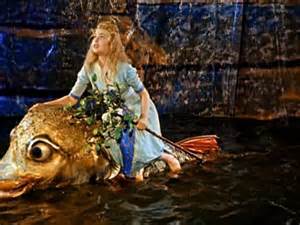
Made in the then Communist East Germany in 1957 it was a Fairy Tale centred on a tree with magical powers together with the key standard ingredients of heroine, hero, and arch-villain engaged in fantastic and perilous adventures involving freakish creatures including an oversized dewy eyed goldfish and a white horse (or possibly a unicorn-I cannot quite remember).
It is not clear which individuals in the BBC Purchasing Department thought it a good idea to buy in a programme from behind the Iron Curtain.
In the style of the Brothers Grimm the Singing Ringing Tree was packed full of hidden messages, political doctrine, moralistic and egalitarian ideals and as such had proven to be very popular in its country of origin although was, before coming to Britain, actually withdrawn from broadcast by the Communist Authorities.
The heroine was a haughty and aloof Princess who was detached from the people, selfish and vain but who became beautiful and beloved through being kind to animals and those in trouble.
The hero, the archetypal handsome hulk was turned by a curse into a most unconvincing grizzly bear in what can only really be described as a brown, shaggy onesie suit.
Their epic battle is against an evil and scheming dwarf who was most menacing in demeanour and motives.
In the Soviet Bloc there had been a directive by Stalin to keep the people feeling happy and engaged in the State even if not actually so. He saw positives in promoting traditional stories in spoken word, singing or acting to engender utopianism and joyous togetherness amongst the great diversity of a communist empire. Even better, a fairy tale could be a cover for political messages and to mould and control young minds.
So what did British children make of the fairy tale/propaganda/subversive aspects of the Singing Ringing Tree?
I was both enthralled and terrified in equal proportions at the 3 part version of the original DDR film when aired across tea time on school nights especially in the winter months when at 5pm it was very dark outside.
This soon became a bit of an obsession, a bit like staring at a dead animal carcass in the road or picking at a crusty scab on a cut knee, very much bordering on mental disturbance.
The original production was in glorious colour but as my family did not own a colour television until 1985 I can only visualise the images and action in graphic black and white. This perhaps accentuated the stark communist message contained in the gradual awakening of the Princess to a social conscience and the conflict against a fascist dwarf. In some respects the programme was rude, crude and lewd but also emotionally touching and with an ultimate redemption for the righteous and just.
Getting on with my life as a responsible adult I often put the experience of watching the Singing Ringing Tree well at the back of my mind.
However, whenever in a group of my peers it is never too long before we begin to speak in hushed tomes about the collective consciousness generated by exposure to this programme. Many of my contemporaries, now in their early 50's appear not a little traumatised by what started off as an innocent bit viewing over a typical weekday tea of baked beans or spaghetti hoops. I can see the signs in the form of a bit of a nervous twitch or a furtive search for activity in the street or across a crowded public bar which could announce the imminent arrival of the State Secret Police.
The very strange goldfish
 |
What a lovely couple
Wednesday, 14 October 2015
Hull Fair; In celebration of.
Hull Fair is a festival for the City.
It is magnificent that the travelling week long Fair retains its status as the largest of its type in Europe and possibly the world.
There are many challengers but I can confidently say that the people of Nottingham in particular have had a fair goose-ing again this year based on the 2015 Hull Fair.
I was going to write about the Fair from an historic and reflective aspect. Something like, for the 18th Century;
"I drove my beast and fowl all the way along the Anlaby Road Turnpike for to sell and trade on the showground but got turned away by the Police Community Support Officers and then incurred a penalty fine for inappropriate use of the bus lane for herding"
or, 19th century ;
"I travelled to the fairground by hansom cab, cost me a silver shilling which is outrageous profiteering, and proceeded to have my frock coat, gaiters and spats ruined by the many puddles on the rough landed area. Subsequently and to my horror my top hat fell off on the Waltzers and I got stir fry noodle stains and Bratwurst on my irish linen shirt front"
or popular 20th Century;
"I was at the fair in my full Teddy Boy gear cruisin' and a-bruisin' for a bust-up when a large group of Emo's approached and made me feel quite melancholy and gawdily over dressed. They always look so clean and stylish or, my Bay City Roller scarf, tied tightly around my wrist got snagged on the top of the junior roller coaster and I had to be cut free and rescued by the emergency services"
and, finally, current 21st century;
"We went, yeah, on the rides, ok, yeah and it was minging, yeah because Chazzer right, tried to take a piccy, yeah, on his i-phone but wicked, right his mam tagged him, yeah and, right,he had to go back to the school, right, yeah to teach a year 12 class, yeah, LOL. Catch us on Facebook or Twitter"
I opted, however, for a more socio-economic approach mainly because there have been many letters sent to the local press in criticism of how, in dire times of credit crisis and cut backs, people still have disposable income to lavish on the attractions of the Fair.
Let me be clear on my position on this.
The week of Hull Fair is as set in stone in the family calendar, outlook express and text alerts as nothing else apart from Easter and Christmas and is therefore budgeted for.
In the weeks prior to the arrival of the Fair there is a noticeable shortage of 2p's and 10p's in the local economy because they have been secreted away for the slots and falls.
Small children are subversively indoctrinated with Peppa Pig and Toy Story so that they are more than thrilled to be bought a foil based inflatable of their favourite characters.
Menfolk frequently disappear to their sheds to practice throwing darts at playing cards stuck onto odd pieces of melamine kitchen worktop.
The Atkins or other high protein diets are accelerated in preparation for being surrendered to a polystyrene tray of Bob Carvers's gritty chips, mushy peas and a pattie.
Teenagers are seen stretching themselves from door frames or on the climbing apparatus at the reccy lest they fail to reach the minimum height for going on the Hammer of Thor, Upside-Downie, round and roundie Mega ride.
The Fair is for all ages and it is perfectly possible to pass a few hours there with little or no expenditure other than a paper wrapped packet of Wrights of Brighouse brandy snap and a past best sell by date pomegranate.
The whole event is about atmosphere. It is a collective enjoyment of a heritage and feeling shoulder to shoulder with fellow citizens who are also having a difficult time making ends meet or have an unopened letter on their kitchen table from their employer which is just too hard to get around to opening because, odds on, it is not a thank you and a hard earned and fully justified bonus.
That is just not plain fair. There are not many things, after all, in our modern lives, that are.
Subscribe to:
Posts (Atom)