Friday, 14 July 2017

Ready, Unsteady, Go

One of the greatest regrets in my adult life, and I can truthfully say that I do not have many at all, is that I never got to take part in a Dad’s race at the school at which my three children attended. 

I am not sure why what used to be a pivotal event (alongside, of course the Mum’s race) was never held over the four year window of opportunity that coincided with that period in my life. 

It may have just been the policy of that particular Junior School, the overriding Education Authority or down to a lack of enthusiasm for such a competition amongst my peer group of playground fathers. 

Personally I think it was because of a social and demographic trend. 

The summer sports day was typically held in an afternoon towards the end of that term. Pressure of work and a lack of empathy amongst employers will have made a request for leave of absence for such a reason to produce an awkward atmosphere. Most of my contemporaries at the school gates may have felt that in their roles as step-dads,, boyfriends, partners, benevolent “uncles” or just neighbours doing a favour that their entry into a traditional Dad’s race would be fraudulent. 

On a more realistic level, and given that I am nowhere near as fit and athletic as I used to be or would aspire to, the disinterest in a short and fierce running race will have not appealed to those like me of challenging physique, unsatisfactory body mass index or those with hereditary or other ailments, not withstanding the possibility of pulling a muscle, rupturing a quad or ligament or something way more serious and life threatening. 

In those years of just waiting for a chance to participate I knew for a fact that the school did not have, in its standard equipment, a defibrillator and I could not remember which members of the permanent school staff were trained to a level of proficiency in administering CPR. 

My attendance at school chucking out time was as part of my working day and I would often have to rush to the back gate between appointments to pick up one or more of my children. In suit and tie I stood out from the other males on collection duty as they were mostly in casual or leisure clothing. In fact, you would be justified in thinking, from their attire that they were just arriving to take part in a sporting event. Talk about top brand trainers, trackies and designer logo’d polo or branded football shirts. Some afternoons I felt like I was an onlooker for a photo shoot for a Sports Direct or Jacomo brochure. 

In hope of one day being called to starters orders every June or early July I made sure that my old spiked track shoes were always somewhere in the boot of my car. They were certainly well used as in my student days I had represented Trent Polytechnic, Nottingham  at sprint events from the Dorothy Hyman Sports Stadium in Barnsley to Alsager in Crewe and other places in between that I cannot remember the name of. 

I could, because of their quiet anonymity, quite easily have sneaked those lightweight wonders onto the school sports field and slip them onto socked feet without drawing attention to their serious intentions. 

Even now, with my children in their twenties, in vague moments of daydreaming I often imagine what winning a Dad’s race would be like.  

Alas, it was never to be. 

I blame political correctness and that generation before me who were deprived of the expectation and thrill of competing to win so as to have no ambition or will to do so if the opportunity arose. 

I was therefore pleased to hear that the parents race was making a comeback in some local schools. 

If I keep myself in good shape I may be able to sneak in a stellar performance one day in such an event although I expect that when that time comes my grandchildren, sat amongst their classmates on the grassy trackside, will disown me. 

Thursday, 13 July 2017

Bangers and Merckx

I was a bit geeky as a child and was always fascinated by the next thing, whatever that was.

In one summer holiday period I displayed an obsessive desire to be, in what I recollect as the correct chronological order,

1) In the US 7th Cavalry
2)Apollo Mission Astronaut
3)Racing Driver
4) Professional footballer
and, strangely,
5) A show jumper.

All of these career ideas were spawned by, following the same numbering, saturday morning cowboy films, Cape Canaveral rocket launches, Le Mans 24 hours, an FA Cup Final and latterly an invitation to the Burleigh Horse Trials in Lincolnshire.

In my late teens I became interested in cycling.

It was another of those genetic traits inherited from my late Father, himself a very keen and well travelled cyclist following on from an affinity to pick up litter in public open spaces.

In the 1980's TV coverage of cycling was very limited. Only a few enthusiasts knew about the Milk Race in the UK to the Classic European Races and the National Tours.

That was until the big sponsorship by cereal manufacturers Kelloggs who promoted some great city centre criterium races with prime time commercial channel coverage. The viewing figures and sheer numbers of on-course spectators must have taken the programmers by surprise and to capitalise on this there was an up-scaling of coverage with  The Nissan Classic in Ireland and then Channel Four began their excellent live and highlights broadcasting of the Tour de France.

I began to compete in local races in the early 1980's and began to live, eat and sleep all things cycling, If not out training, taking part in events or sitting glued to the TV the best thing to do was to catch a live event out in the countryside or in a town centre. A few of us would ride miles, often setting out at first light, to be in a good roadside spot to catch the race as it passed by.

I did get to see a stage of the Tour de France in 1984, setting off on my own from the house near Paris where I was staying for a week with my younger sister, at that time nannying for a French family. It was quite an ambitious thing to do in a strange country, with only schoolboy language skills and a large scale map that covered from the Scottish Lowlands to Morocco.

That flash of the pre-race publicity caravan, motorcycle outriders and then the riders themselves was absolutely thrilling, albeit over in all too short a time.

My journey in cycling has been and still is quite a surprise to me.

I was a poor and very under-achieving competitor in a very brief foray into racing but have two small trophies for "Best in Club" for one particular year.

In my late twenties Self employment allowed me to sponsor a local cycle racing team in my home town over 15 good years before the banking crisis and recession. My son has started to compete and trains hard.You can find me following some distance behind.

I continue to enjoy the sport and hope to stay fit and healthy to continue to ride out when I get an opportunity. In this way I have been able to live out an obsession, now the longest single one in my catalogue of obsessions and fascinations.

I was therefore quite taken with the achievement of one Alex Clarke, whose story has some paralells with my own.

He started off collecting and selling vintage bicycles in the US before acquiring a consignment of classic cycle team jerseys. These sold well through the internet and his natural thought was to capitalise on this demand and actually make replica jerseys using modern Merino Wool.

The baggy and obviously very hot woollen team wear, both shirts and shorts in the 1970's included some gawdy and striking designs such as Brooklyn, Bianchi, Dreher, Sammontana, KAS and Jolly Ceramica. One jersey design that Alex Clarke openly avoided was Molteni, the team of Eddy Merckx and before him Motta, Altig and Basso.


However he had an open mind and meeting a well known Italian Cycling Photographer convinced him that Molteni embodied the core values of cycling.

The Molteni team was financed not by a large pan-European Corporation but a family firm who made award winning sausages.


Clarke's new obsession saw him spend thousands of dollars of his own money on turning a plain and drab 1976 Volvo 244 Saloon Car into an authentic replica of the Molteni Team Car that accompanied Merckx and co on some of their greatest exploits.


The result is striking and I am, I admit, just a little bit jealous.

Wednesday, 12 July 2017

EnTourage

Ahead of tomorrow's  blog about the replica Volvo team car for the Eddy Merckx team of the 1970's I have ventured into the wider world of vehicles which form the entourage for the great cycle races in Europe and worldwide. Here are just a few of the more interesting ones.

Alfa Romeo-Bianchi 

Unofficial do it yourself Sky Jag
The classic Merckx Volvo 244


Big Citroen-1980's

Huge station wagon-stateside

Peugeot-Vintage Tour de France
Peugeot-Peugeot

Volvo 244 as fashion icon

Tiny Fiat

Milk Race traffic jam

Early Japanese sponsorship

More Alfa's

1970's Peugeot's- model and real


Merc in the snow


My own Volvo 850 for The Lands Classic, 1990's

That 244 model again


Tuesday, 11 July 2017

Cycling Book Guide

Too engrossed in the televised coverage of the Tour de France to actually go out on your bike?

Well, the next best thing is to pick up one of the many cycling genre books on the market and become immersed in the facts, fictions, follies and thrills of the Grand Tours, the characters and the tactics.

Here is my list of favourite bits of writing in no particular order;


The story, inspiring and tragic of Dave Rayner, a Sheffield rider who rode on the continent and was destined for great things only to be killed in a city centre incident.

His legacy, The Dave Rayner Fund, has given the chance of European competition to many British cyclists with its
beneficiaries now performing at the Elite Pro level.


A coffee table book with route maps of all of the Tours de France up until the Yorkshire Grand Depart in 2014.

I enjoyed using the maps to try to work our where on earth I saw the 1984 race from the roadside astride my own bike.

I am none the wiser but have some 35mm prints to prove that I was there.


A chance to look up all of those team and national jerseys across the years that you came across in the pages of Cycling Weekly and other bike magazines.

Some classics and some shockers.


One of the first candid and honest factual works by a rough, tough Irish Rider, Paul Kimmage.

He was a domestique or general support rider at a time when non-Europeans were a rarity and a novelty in the peleton.


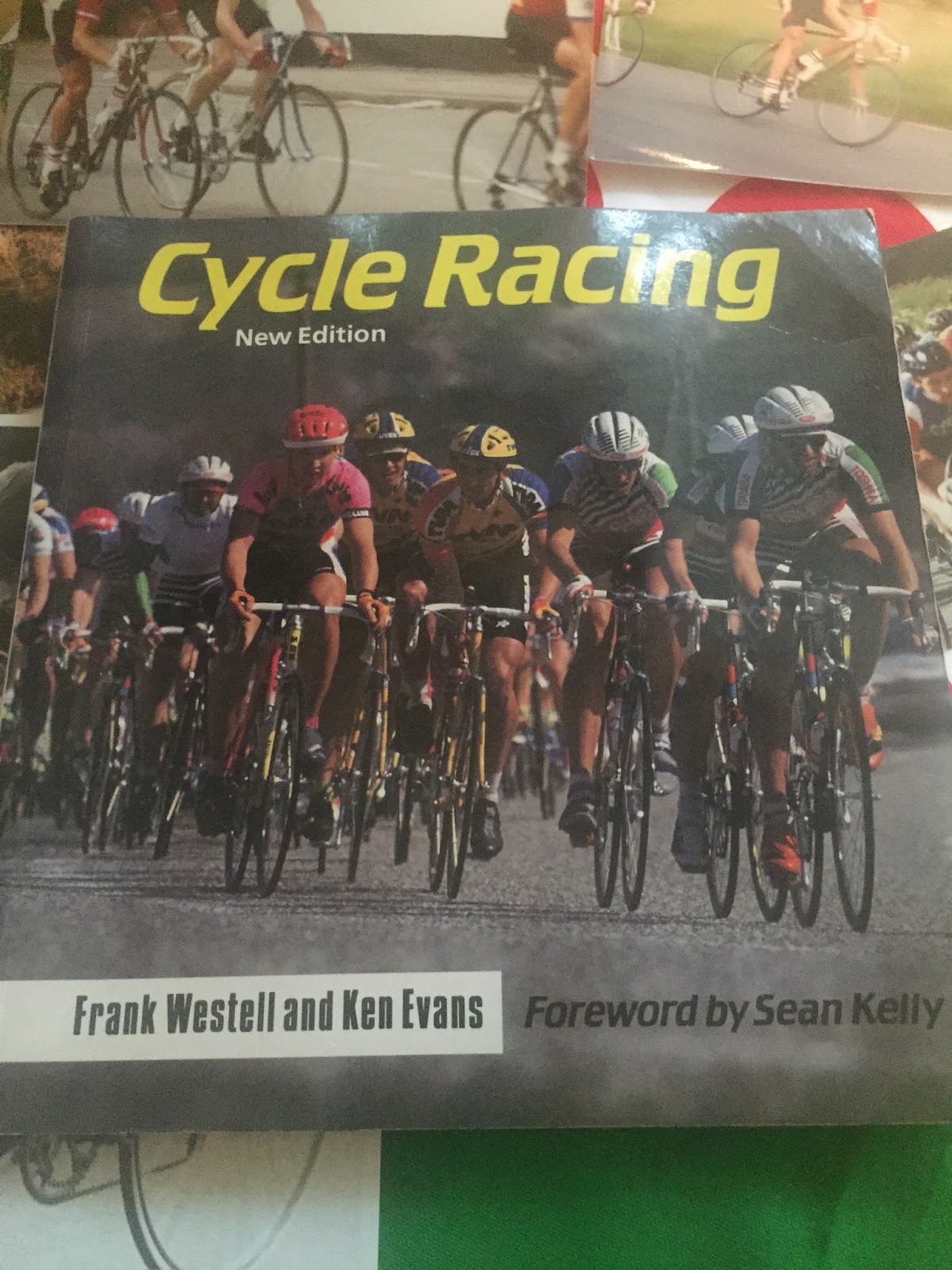
A text book covering the basics of getting into cycle racing.

Useful for those thinking about competition but of course nothing can really prepare you for the reality of a lung busting, leg aching and terrifying experience in that first event on the road.


This guy must have been good at the text book theory to have been so exceptional in dominating the racing scene for so long.

A one in a million athlete.


A great story of genius, perseverance, success against the odds with a backdrop of personal trauma by and about a very single minded character.

His battles with Chris Boardman on the track are things of legend.


The enigmatic Irishman figured amongst the emerging non-European riders in the Grand Tours with Kelly, Millar, Peiper, Anderson and the Americans of Lemond and Hampsten.

Roche achieved the triple of the Tours of France and Italy and the World Championship in the same year.


A fascinating book about the rivalry between these two greats and with modern day interviews on what really went on in what has been called the greatest ever Tour de France.


The darkest side of pro cycling is depicted in this confession style book by Tyler Hamilton, one of the former team mates of the disgraced Lance Armstrong.

The book blows open the doping epidemic in the peleton which was known but suppressed from the public.


I just find myself coming back to re-read this book about an ordinary man taking on and riding the route of the Tour de France.

There are some real laugh out loud moments between the sympathetic emotions and tears.

For those thinking about starting from scratch this book is inspirational.


Just finished this backstage account of the 2004 Tour de France by the former manager of The Clash.

Wandering freely around the race village and press centre there are some opportunities for mischief and mayhem.

The writer, his son and a lawyer friend get hold of an Official Pass and make the most of the buffet and freebies as well as putting 5000 miles on the odometer of a hire car.

A warts and all account which is eye opening and refreshing.


Monday, 10 July 2017

Revolution and Love

It is that three weeks of the year when the Tour de France dominates my waking hours and in part, my restless dreams. 

I re-enact, through the slick TV coverage, my own patchy exploits in competitive cycling when much younger. 

Although the same sport there is a vast difference between a National Tour and the sort of events that I participated in- usually in the unsociable early hours of a sunday morning on some deserted stretch of trunk road or on a rural circuit under the gaze of a few inquisitive sheep and cows. However hard you wished there were never any team cars or mechanics. If you suffered any physical afflictions or bike failure you then you had a long walk ahead of you to get back to the village hall that served as race headquarters.
1985- middle of nowhere, Yorkshire
My racing days were back in the 1980's when cycling in the UK was very much a minority sport, the domain of a few dedicated participants and an army of volunteers and enthusiasts.

It was simply not a trendy activity. 

Then came Channel 4 coverage of the Tour de France in 1986 which brought cycling into the mainstream for a wider audience. I came across some of my old VHS recordings of the early years scheduling but now unplayable as I do not know anyone who still has a workable video player. 

Fast forward to the last few years and the roads and byways are crammed full of weekend racers and leisure riders. 

This year has seen full start to finish coverage of the Tour de France Stages for the first time and I have dipped in and out of the daily four to six hours broadcasts enjoying every single second of action and the tactical build up to sporadic action before the frantic final kilometres. 

The bike is now very popular in this country which is no mean feat given the fiercely guarded status in traditionalism and nationalism of the minority sports of cricket and tennis. 

After watching,  from the comfort of my sofa, a momentous first weeks racing in France I have been re-energised in all things cycling and in celebration I would like to reproduce this wonderful poem by Pablo Neruda which captures the atmosphere surrounding, as well as the essence, romance and purity of, the bicycle. 

Not bad for an inanimate object, not bad at all.

I was walking down a sizzling road: 
the sun popped like a field of blazing maize, 
the earth was hot, 
an infinite circle with an empty blue sky overhead.

A few bicycles passed me by, 
the only insects in that dry moment of summer, 
silent, swift, translucent; 
they barely stirred the air. 

Workers and girls were riding to their factories, 
giving their eyes to summer, 
their heads to the sky, 
sitting on the hard beetle backs of the whirling 
bicycles that whirred as they rode by bridges, rosebushes, brambles and midday.

I thought about evening when the boys 
wash up, sing, eat, raise a cup of wine in honor 
of love and life, and waiting at the door, 
the bicycle, stilled, because only moving does it have a soul, 
and fallen there it isn’t a translucent insect 
humming through summer 
but a cold skeleton 
that will return to life 
only when it’s needed, 
when it’s light, 
that is, with the resurrection of each day.


- Pablo Neruda, 1956

Sunday, 9 July 2017

Tongued and Grooved

It has been 60 years since the pine floorboards of the rear living room at my Mother in Law’s house have seen the light of day. 


As a newly married couple George and Maureen moved into the house in 1956. 

At that time the property was already well established having been built on land conveyed in 1920 from the Alexander Land, Property, Mortgage and Investment Company to a Charles Sweeting who is likely to have been the builder and with the first occupant being a Mr James Walker. 

The quality of the pitch pine floorboards is exceptional after all these years. 

No patching or splicing has been necessary which is quite remarkable given the potential for rot, decay and infestation notwithstanding general wear and tear from many hundreds of thousands of footfalls over the lifetime of the house. 


I have seen many a wooden floor in similarly aged property which has simply disintegrated from the influence of wet and dry rot and the munching activities of boring insects. The floorboards at Maureen's were laid in the traditional manner running across the room from passage side to the understairs and therefore with the supporting joists resting at the base of the rear external wall and under the middle partition wall between the two living rooms.

In this way the joist ends can be at risk from any dampness on the outside wall but I can say that from my jumping around on the floor there is no sign of weakness whatsoever. A perforated or weak joist is easily detected even without being seen. The first indication is a dull resonance and the second and confirming feature is when you find yourself falling through the rotten timber into the sub floor space. 

The original pine boards, to attain their durability, will have been allowed to become seasoned over a number of years in a timber yard or even the builders own workshop. The wood is beautifully grained and knotted unlike a lot of modern boards which have to be securely nailed down to prevent the poor quality timber twisting and warping. 

Of course, in the first quarter of the 20th Century a full wall to wall carpet in a home was still something of a luxury. The necessity rather than the fashion was to paint or woodstain around the border of a room floor and have a carpet square centrally positioned. This had in fact been the practice more than two centuries before in even the most affluent households. 

Another popular measure was to overlay floorboards with linoleum or what was known as canvas, and this was usually done straight away in a newly built house. This action preserved the wood in fresh and new condition. 

There was a severe shortage of construction timber at the end of the 1914-1918 war and in a house that I owned which was built around 1919 this was evident in that the floorboards were of small section and likely to have been recycled from use as ammunition boxes.


The carpet, until today concealing the floorboards, cost £5 a square yard in 1956 which inflated to the present day would be around £87 and converted to metric the equivalent of £100 a square metre, the price of an exceptional hand made floor covering. 

If you take price as an indicator of quality then the old carpet will have been of the highest. It has certainly given good service in the house where Maureen and George brought up three children, and in that particular room which remains as the hub of life and hospitality. 

In the 1970’s it was a trend for floorboards to be exposed, stripped and varnished but this soon fell out of fashion with a return to soft furnishings in the next decade and more recently with laminate and real wood. The floorboards are certainly in suitable condition for this type of retro-finish and would require very little by way of cosmetic attention but the resultant noise and draughtiness is too much of a trade-off. 

The newly exposed floorboards at Maureen's do have some minor paint splashes in Corporation type green which my wife, who is now in her early 50’s and spent her formative years in the house, recalls as being the gloss finish to the old kitchen door. The painting of that door could have been one of the first household maintenance jobs carried out by the newly wed George upon taking up occupation in the desire to make the house into a home which it has been for well over a quarter of a century.


The old boards certainly have some stories to tell. 

Saturday, 8 July 2017

Cut above

Is the barber shop the last refuge, a sanctuary for men who just want to be, well, men?
In patriarchal days gone by just about everywhere was the male preserve from the workplace to the public house, chip shop, clubs and societies. 
I am of course what is called a "new" man in that I am of the generation that went through co-education,the era of equal rights and general enlightenment in relationships and behaviour between men and women. 
There are, it is very plain to see, some of my gender who cannot accept parity with the fairer sex and so seek out those places where they can be assured of a degree of male exclusivity. 
This minority are not misogynists or chauvinists but simply feel that they cannot truly express themselves or open up on sensitive or taboo subjects if there is a likelihood of being in female earshot. 
The barber shop even in my lifetime did serve a valuable role to its male customers. Yes, many were dingy, dirty and seedy places on the High Street of every town but there was comfort within and a non-judgemental and non pressure culture, that being if you could survive the banter, wit and humour of the patron and regular customers. 
I simply followed in my father’s footsteps in my choice of local barber and as a child would be squashed in on steamy Saturday mornings amongst the pensioners and those looking forward to a night out with wives and girlfriends. 
It was only when I was in my teens that I ventured into a ladies salon or new style unisex. They were, in direct contrast, bright and trendy but then again at the prices they charged over a barber shop tariff a degree of comparative luxury was expected. 
I enjoyed, in my adolescent years, that brushing of the neck by the bosoms and warm breath exhale on my ears of a female stylist as they worked around the chair. No wonder I would get into a bit of a hot flush but it was worth it. 
Stimulating my youthful urges may in fact have been an influencing factor in going to that sort of hairdressing establishment but now, in my fifties, I find myself back in the surroundings of a traditional barbers. 
There have been some improvements to the overall experience with my regular Turkish being brash and fashionable making a visit the highlight of my month. 
I can appreciate,therefore, a new study from University College London that concludes that time spent at the barber’s not only cheers us men up, but could actually be good for our mental well-being too. This is in the current crisis times of an increase in male suicide rates, prostate cancer, depression and stress levels and pressure from modern challenges to stereotypical male roles. 
The study, albeit of a small sample of just over 200 men indicated that some 39% visited a barber's shop for other reasons than getting their hair cut.
So what are the peripheral benefits?
The role of a sort of speakeasy appears high on the list in that "man talk" is accepted and indeed encouraged in a barber shop. It does not mean a retrograde return to the sexist and offensive attitudes and jokes of the 1970’s but more of a harmless entertaining banter which can be a positive tonic to the participants. 
The respondents to the survey reported that ,after having left a session in the barber shop, there is a tangible feeling of enhanced happiness. 
There is a distinct difference in the attitude of ethnic groups towards a visit to the barbers. The afro-caribbean community, for example, were, in the study, twice as likely to report they were “not here for the hair,” saying they also went to socialise, chat and exchange banter with mates. 
Not only is there a cultural and sociological angle to the simple act of going for a haircut but for  health professionals, both general medical and psychological the main point of interest lies in the two most common themes items that men talk about being  “health” and “personal issues”.
It is a clinical fact that men seek professional psychological help less than women do and this leads to the bottling up of issues and problems that could otherwise be well on the way to being diagnosed and managed.
The study paper points to familiar themes that prevent men opening up which include family privacy, lack of knowledge about treatments, and the stigma attached to mental health issues. The barber shop of the modern era, although I suspect this was the case for years, serves as a centre for mental health relief and to promote well being.
There has also been an erosion in what of my father’s generation were the main trusted roles in society. Families tended to stay with the same Doctor, Lawyer, Bank Manager and Priest but with mobility of labour, globalisation ,on line services and the decline in church attendance the continuity of such professions has been disrupted. That has meant that barbers, by default, are the sole survivors of the genre of friend and confidante to men.
It is possible however to take things too far and when a Manchester, UK barber started to offer beers, cocktails and in a women-excluded environment he was condemned and vilified by action groups and the wider media.
There is certainly a balance to be struck to convey the traditionalism of a respected trade and yet encourage men to put aside their natural reticence and embarrassment in personal and health issues so that any cries for help may be heard before that point of no return is reached.

(inspired by an article by Michael Daubney, Daily Telegraph)