I thought that I had seen everything in terms of styles, trends and fashions in the new build housing market.
Going back into the 1970's it was the through lounge replacing the traditional best parlour and back sitting room. In the 1980's the breakfast bar appeared in domestic kitchens. The 1990's saw the emergence of the en suite bathroom. After the millenium it was a case of those fancy fruit bowl hand basins and wet rooms. Current fads are for high tech control equipment, under floor heating and moves towards energy efficiency or self sufficiency. These things are of course all to do with the interior design and specification.
There has over the years been an equivalent transformation of exterior styles and house types. The modern semi detached went from a large brick built box to a more pleasing but still brick built box. The terraced house, once the domain of the working man and woman became trendy and a bit retro although heaven forbid the old practices of neighbours wandering in and out willy-nilly and leaving doors unlocked would be strongly resisted. Executive detached houses have just got larger and more tacky with electronically controlled gates across the cul de sac, private security patrols and heated all weather private estate roads. Three storeys have also become commonplace on the sprawling residential estates that ring most of our larger towns and cities.
A few brave or is it foolish souls do their own thing along the lines of those properties featured on Grand Designs and other cult programmes but to be successful you have to be a bit ruthless and have pots and pots of cash.
Most purchasers of a brand new house would probably prefer that older property but it is just so easy to buy new what with incentives and favourable purchase schemes.
In the last few months the house builders have seen a huge upsurge in demand for their products mainly down to the availability of "Help to Buy" and an improvement in consumer confidence about taking on what is still a major financial commitment.
The larger national builders have responded to the demand by resuming development of sites that had lain half built and dormant since the credit crisis.
The houses actually seem to be getting smaller and more compact and today I came across a throwback house type from the grainy sepia tint period of the late 19th and early 2oth centuries. On a site in a popular commuter town they are building a back to back terraced house type.
I was initially confused by the concept during an walk around the interior and somewhat shocked by the absence of any windows on what would, in a conventional house be the rear outlook. I had to go back outside and take stock.
The house was one of 8 in a long block and yes, there were eight front doors, four on each aspect. It would be easy to be fooled on that first impressionable viewing thinking that you were buying a normal property with its own front and back doors.
Whatever is next in the mindset of the house builders?
The return of the slum? wattle and daub? A wooden stockade around an earth mound or even the return of the cave dwelling?
Tuesday, 13 October 2015


Monday, 12 October 2015
Live Long and Prosper
I was a normal little boy.
It was not that my Mother had me tested and I had a certificate to prove it.
I just behaved like any lad would in certain situations.
Take the distant rumble that indicated the approach of an aircraft.
Whatever I was doing would be abandoned in the frantic attempt to get to a vantage point to identify and appreciate a flypast. Our family house backed onto open fields over flown on a regular flight path by the RAF which in the 1970's meant a daily thrill of Lighting and Phantom fighter planes and my favourite the booming and lumbering delta winged Vulcan Bomber.
The smaller, nimbler front line attack aircraft gave little or no prior warning of their approach. I seemed to have developed a sixth sense about an imminent arrival in the airspace which sent a tingling down my spine and a feeling of anticipation a bit like the seconds before being sick.
I liked to think that but it may have been that I was just used to the passing of the scheduled flights.
The Vulcan was a different experience.
In the far distance there would be a rumbling very much like a summer storm front followed by a rising crescendo of powerful jet engines. Any loose putty bedded window panes emitted a faint rattling under the low frequency resonance.
The planes always flew very low as they began a technical descent to one of the Lincolnshire airfields which could have been Scampton, Waddington or Coningsby even though at some distance to the south and south west of the direction of flight.
The Vulcan was one of the most distinctive flying machines of the post war era in terms of sheer size and that almost UFO type profile when silhouetted against the sky.

In camouflage paint job they looked stunning emphasising the shape and muscle that was designed to carry a nuclear payload over huge distances. They were a response to the Cold War threat with Britain occupying the middle ground between the two dominant super powers of the USA and USSR.
Unfortunately a combination of governmental budgetary constraints, a scaling down of the frosty relations in world politics and further technological advances in military hardware sounded the death knell for the majestic Vulcan.
Up until this weekend one sole airworthy example had survived thanks to public support and the efforts of volunteers. It had been a long process to get the Vulcan to the skies and one fraught with problems and setbacks.
I saw the surviving Vulcan as many times grounded as in the air and although deprived on occasion of that earth shaking blast of engines on full throttle in a steep climb manouvre just seeing it being taxied across the runway apron was enthralling in the extreme.
Vulcan XH558 was on a farewell journey at the weekend covering the length and breadth of the country. The withdrawal of engineering support has ended the entrepid 50 year saga of that particular aircraft.
I did not get to see any of the final flypast but my childhood recollections of sprinting out into the garden, invariably with my trousers around my ankles from being in the loo, to catch sight of the iconic bomber will stay with me forever.

It was not that my Mother had me tested and I had a certificate to prove it.
I just behaved like any lad would in certain situations.
Take the distant rumble that indicated the approach of an aircraft.
Whatever I was doing would be abandoned in the frantic attempt to get to a vantage point to identify and appreciate a flypast. Our family house backed onto open fields over flown on a regular flight path by the RAF which in the 1970's meant a daily thrill of Lighting and Phantom fighter planes and my favourite the booming and lumbering delta winged Vulcan Bomber.
The smaller, nimbler front line attack aircraft gave little or no prior warning of their approach. I seemed to have developed a sixth sense about an imminent arrival in the airspace which sent a tingling down my spine and a feeling of anticipation a bit like the seconds before being sick.
I liked to think that but it may have been that I was just used to the passing of the scheduled flights.
The Vulcan was a different experience.
In the far distance there would be a rumbling very much like a summer storm front followed by a rising crescendo of powerful jet engines. Any loose putty bedded window panes emitted a faint rattling under the low frequency resonance.
The planes always flew very low as they began a technical descent to one of the Lincolnshire airfields which could have been Scampton, Waddington or Coningsby even though at some distance to the south and south west of the direction of flight.
The Vulcan was one of the most distinctive flying machines of the post war era in terms of sheer size and that almost UFO type profile when silhouetted against the sky.
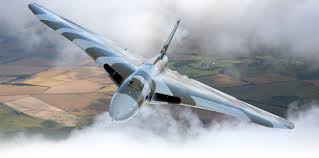
In camouflage paint job they looked stunning emphasising the shape and muscle that was designed to carry a nuclear payload over huge distances. They were a response to the Cold War threat with Britain occupying the middle ground between the two dominant super powers of the USA and USSR.
Unfortunately a combination of governmental budgetary constraints, a scaling down of the frosty relations in world politics and further technological advances in military hardware sounded the death knell for the majestic Vulcan.
Up until this weekend one sole airworthy example had survived thanks to public support and the efforts of volunteers. It had been a long process to get the Vulcan to the skies and one fraught with problems and setbacks.
I saw the surviving Vulcan as many times grounded as in the air and although deprived on occasion of that earth shaking blast of engines on full throttle in a steep climb manouvre just seeing it being taxied across the runway apron was enthralling in the extreme.
Vulcan XH558 was on a farewell journey at the weekend covering the length and breadth of the country. The withdrawal of engineering support has ended the entrepid 50 year saga of that particular aircraft.
I did not get to see any of the final flypast but my childhood recollections of sprinting out into the garden, invariably with my trousers around my ankles from being in the loo, to catch sight of the iconic bomber will stay with me forever.

Sunday, 11 October 2015
Parent Trap
We, as a family, very much post nuclear having 3 rather than 2.2 children, have been committed to days out with some potential for educational value.
This intention does not have to mean a determined commitment at all costs but rather as part of a wish list.
This in mind our offspring, when young and reasonably receptive were taken (in no particular chronological order) to such delights as The Millenium Dome , Natural History Museum, Magma, Legoland Windsor, The Earth Centre, Tintagel Castle, Other Castles and Military Forts, Edinburgh Zoo, Tate Modern, Science Centre Glasgow, Imperial War Museum Manchester, Eureka in Halifax, Bradford Centre for Film and Photography, National Trust and English Heritage sites, various official and unofficial Sea Life Centres, Torture Exhibition, RAF Museums, Motor Show, Eden Camp, Forbidden Corner, Kinderland, Flamingo Land, Yorkshire Sculpture Park, York Railway Museum, London Eye, Vindolanda, Iona, Hull Tidal Barrier and Australia Zoo. (There are just too many to remember)
There is a bit of a pattern in the venues if you consider my own particular interests in all things natural, war and conflict, inventions, industrial processes and media.
I do feel however that I am beyond reproach for being in any way selfish or in manipulating the thoughts of impressionable children by taking them to such places. The fact that our youngsters, now all in their 20's have turned out as good and responsible citizens I attribute in part to the stuff that they were exposed to in their formative years (this excludes trauma and post stress disorder from witnessing an aircraft crash and other collateral events inevitably encountered when out and about).
There is inevitably a price to be paid for such an active programme of entertainment.
Most of the aforementioned attractions do of course have an entrance fee which for a family of our above average size (statistically) can be a tidy sum but this is absorbed in the normal weekly or special holiday budget for such things. Travelling to and fro incurs petrol and ancillary costs but these are known quantities and controllable by careful driving habits. Lets face it, an estate car fully laden can only be driven so as to maximise fuel economy. Even refreshments can be to within a controllable cost base if there is advanced purchase of soft drinks, crisps and other snacks in packed lunch or loose buffet form.
Most of the above do not require any special equipment or clothing which can otherwise represent a big capital outlay.
I have been known to go to great lengths to research attractions of a free or discretionary contribution type but as most parents know such places are few and far between.
The principal fear of parents remains in the guise of the Gift Shop.
The children can seem perfectly content to trail around the exhibits and operate the interactive displays such as an earthquake simulator, steel production process, TV news broadcast studio and Lego car driving school and there is a tangible increase in their motor skills and appreciation of the world at large.
However, upon seeing the delights and enticements of the Gift Shop something strange overpowers them and brings out the worst excesses of consumerism and materialism.
This can be very distressing for a parent to witness.
All Gift Shop managers are extremely cunning as they know that in order for parents to extract themselves and their charges necessitates a purchase or multiple purchases. These are typically well above reasonable pocket money levels.
The range of goods on sale are generally 10% relevant to the attraction with the bulk brought in from the sort of emporium that supplies tacky seafront shops or London souvenir kiosks.
I try to steer interest towards the basic minimum purchase of a notepad and pencil topped with an eraser but this is difficult under the frowns and condemning glances of the shop staff as in "what a tight and unloving dad".
Our children did collect Beanie Babies which, unfortunately form part of the 90% of the stock of Gift Shops and so an exit strategy could be very expensive indeed.
One particular theme of item that I was keen to encourage was toy animals.
Regardless of their relevance to the attraction they were always present and within acceptable price limits. The quality did vary significantly and as a discerning parent there was some angst in recommending the more realistic figures at full price rather than slightly cheaper, poorer ones being quite scary representations of a shark, cow, dinosaur or freakish mutant combination of them all.
If the calibre of a childs' upbringing can be adjudged by their collection of toy animal figures then I offer in our parental defence the following photographic collage.

How many Meerkats can you see? Answer via the Comments button please. No prize offered
Saturday, 10 October 2015
Noah, 'arking on about a lot of things
Continuing on from yesterday I have been studying the relevance of old words to modern everyday life.
My Source, the 1866 Websters Dictionary was a pivotal and authoritative work of its era and will have sat on the hardwood shelves of many an educated or well to do family.
It was a great labour and commitment on the part of Noah Webster borne out of an intention back in 1829 to publish a dictionary of the English Language exhibiting the origin, orthography, pronunciation and definition of words.
A high-brow intellectual tome it was also advising on the different pronunciation by different Orthoepists, how to speak the names of classical characters from Greek, Latin and Scripture and a vocabulary of modern geographical names with the emphasis of saying them correctly.
I continue my analysis and interpretation from;
Nectarous (sweet as nectar). Getting double bonus points on my Sainsbury's shopping is what I call nectarous.
Odoriferously (producing odour). We all looked at each other in the confined space of the passenger lift when it became all too evident that someone was odoriferous in a silent but deadly manner.
Pettifog (to do small business). Apparently according to the Government the backbone of the econony in Britain is down to those that pettifog.
Quassation (the art of shaking). Mr Bond, how would you like your Martini? I prefer it quassated and not stirred thank you very much.
Rumple (to make uneven). Left with the fat kids and the lad with the squinting eye we knew that our footie team had been well and truly rumpled.
Septentrional (pertaining to the north). A three wheeler car, fur trimmed jacket, flat cap and a wicker basket full of racing pigeons is just so last years septentrionalism.
Thomsonite (a member of the zeolite family). I was not aware that I had descendants that had come from Zeolitia, must be on my paternal grandmothers side.
Uphers (poles used in scaffolding). Zbigniew and his uphers were first choice in any construction project when it came to high rise work.
Vang (the vangs of a ship are a sort of braces to steady the peak of a gaff). I've got two of these just in case.
Wankle (weak, unstable). A long known about design flaw of a Rotary Engine found in some Mazda Cars.
Xylophone - a musical instrument not evidently in existence in 1866.
Yawl (to cry out). Yawl get the toe end of my boot if you persist in being a nuisance my man.
Zeolite (a family of minerals). Those sending begging letters to the Thomson family either claiming kinship having been misguided by an ancestry web site or undertaking a speculative venture to get a cheap holiday.
Friday, 9 October 2015
Noah Webster and that book what he wrote
We can learn a lot from the lessons of the past.
Take, for example, the rich heritage of the English Language and its fluidity of development over the generations. To illustrate the dynamic nature of words I have dipped into my trusty, thick and fusty edition of the Dictionary of Noah Webster LL.D in its tenth edition from 1866.
I acquired the book for a few pence at an auction house some 30 or so years ago and I find myself forever wandering back to the attic to retrieve it to consult on a matter of pronunciation, derivation and spelling or to just cheat at Scrabble. I intend to show the relevance of certain words, long since forgotten in everyday conversation, and champion them to return victoriously into our modern vocabulary.
Abalienated- (transferred from one to another) as in "I went to the Bank to withdraw some funds from my current account in order for these to be abalienated into my savings account"
Beslubbering-(to smear with spittle). "When I purchased the postage stamps from the Post Office I mistakenly purchased the non adhesive type and underwent the public humiliation of beslubbering them in order to catch the last post"
Crizzel-(a kind of roughness on the surface). That Cillit Bang is useless if there is any crizzel in the bathtub.
Deracination (act of pulling up by the roots). I was the victim of deracination when it was discovered that my parents were not members of the nobility.
Effrenation (unruliness). I was involved in a bit of effrenation in Tesco's over a misunderstanding with a very similarly laden trolley to my own.
Fisk (run about). The MOTORS FOR SALE sector in the local paper advertised a Ford Fisk.
Granitification (being formed into granite). In the purposeful resurrection of an old magic spell he intentionally turned himself to stone ie self gratification granitification.
Huck (haggle in trading). After an attempt to negotiate a reduction in some cut price fresh fruit the stall holder told me to Huck Off.
Impurpling (tinging with purple). After walking into the closed door I could feel my nose impurpling on my face.
Jub (bottle or vessel). He was keen on recycling and often took his empties down to the jub centre.
Kerchiefed (dressed, hooded) The sun was beating down on Skegness Sea Front and many of the holidaymakers were appropriately kerchiefed.
Lumbriciformous (Resembling a worm in shape). It was not until the women on the bus pointed and screamed that I was aware there was something lumbriciformus protruding below the front of my zip up jacket.
Mity (abounding with mites). It was a mity problem in our house when nitty-nora arrived on the doorstep.
to be the subject of perduration.
(repeat from last year)
Thursday, 8 October 2015
Acres and Pains
Over the last 30 years of working in the property industry I have honed a few skills.
I know the names of the brick bonding patterns found on older buildings, I can identify types of damp proof courses and can spot a king post trussed roof across the murkiest of loft voids.
I have a good perception of the physical size of all types of houses and can estimate quite closely the floor area before carrying out the prescribed form of measuring for more formal purposes, ie calculation of insurance and for comparable database entries.
These are all issues within the four walls and more of a house.
I can also mentally perceive the size of a garden plot or larger landed area which is something that many seem to have problems with.
I am often asked how big is an acre, that iconic quantity of land, by those who cannot visualise it.
In its original definition an acre was the amount of land that a farmer could put to the plough in one days work using an ox. There are some variations to this interpretation in, for example, the United States.
One acre extends to 43,560 square feet or roughly an area some 70 yards square. I do refer to metric units in my professional workload but only after having referenced it in good old inches, feet and yards. This may not mean much to some because they may not have an opportunity to mark out such an area.
This is where it is easier to use common examples to help.
The media, if seeking to explain the size of something such as the aftermath of an explosion, pollution outbreak or champion sized omelette always use the analogy of a football pitch. Being the alleged national sport of the UK there is a very good availability of actual pitches and stadia on which individuals can pin their perceptions.
A competition sized pitch is about one and a half acres and so an acre would be two thirds the area. Of course the Football Association in the UK has guidelines for the minimum and maximum size of pitches and so there can be some inconsistency across the range.
What other things can be used to help in the gauging of what an acre looks like?
Followers of tournament tennis may be interested to know that an acre would be represented by around fifteen and a half full tennis courts.
Nationalistic interests, if to be considered could be used. Wales, part of the United Kingdom, has a land area of about five million acres and so logically an acre is one five millionth of the Principality. This may not be very helpful unless you are Welsh.
The trendier urbanites could use an example of an allotment with around 16 traditional plots to an acre. Chances are that most allotments have been built upon to meet the demand for new housing. Taking a typical executive property of around 2400 square feet the said former cultivated land could accommodate 18 units. Other greenbelt or brownfield land may be occupied by an out of town supermarket. Although the covered part of a large retail store is only about 0.6 acres if you had space to park 150 cars then this would make up an acre.
This rough guide to visualising an acre may have been helpful.
An acre is an acre but dependant upon its location and physical attributes there could be a vast difference in what it is worth. I may talk about this as a separate topic at some time in the future.
Incidentally, you could, if with limited finances just opt to buy an acre on the surface of the Moon currently retailing at around £20 all in but then you would have to take this in good faith and with a bit of justified scepticism.
Wednesday, 7 October 2015
Measure for Measure
I have not, for many years, heard of any contemporary applications of what used to be the first perception of measuring for a child in the use of fairy steps.
I can remember many games and pastimes at home or in school, usually those played with real or imaginary friends, where the fairy step came in very useful to define space, allocate territory and segregate participants. The distinctive heel- to toe-to heel -to toe movement, often with an exaggerated throwing out of the leg or if done rapidly more like a penguin walk, was regularly used as an integral part in pre-school or infants school play activities . Even in senior school it was adopted to set out the distance between coats and blazers for a goalmouth for a break-time soccer game. If the match deteriorated into a brawl or mass scrap close to the goal-line then the fairy step was used to mark out the position of the penalty spot. The end of year and spring terms were mostly football but with the final school term before the summer holidays it was cricket or rounders with the fairy step returning to prominence as an easy and widely accepted medium of measurement to set out the pitch.
I have started to tentatively explore the viability of the wider adoption and use of the fairy step in business and commerce. I am fortunate in that my adult size 10 feet, when shoe'd are exactly 1 imperial foot or 12". This of course is confined to sensible and stout work shoes of a Clarks, Hush Puppies or budget Brantano calibre and not winkle-pickers, brothel creepers or those flat ended fashion shoes of Italian style and panache. Experiments in the accuracy and reliability of a size 10 fairy step over relatively short distances have proven very successful against a Swiss precision made laser device, the stalwart of a reinforced vinyl tape and an antique wooden measuring stick. There are some inevitable disadvantages particularly in the implementation of fairy steps where items of furniture form an obstacle for a clear run across a room not otherwise a problem for a red-spot laser beam or a tensioned tape. There are severe limitations in outdoor areas where ditches, rivers, lakes, seas and oceans are encountered.
The general public may also express some distress at the sight of a practitioner in the process of fairy stepping as this involves a head down stance, mutterings of counting consecutively and of course the often comical body movement which is an inevitable feature of the process. Ideally, the presence of an assistant would be required to attend to the counting and also to offset any public animosity or aggression but that could have severe implications for the financial viability of the system. I can see that its application for long distance measurement is rather limited as it takes a lot of concentration to keep in a straight line particularly on a windy day and the actual physical requirements are quite exhausting. It is very possible to incur an injury through a clash of ankles, pull a muscle or even throw out a knee or hip joint from inattentive or careless actions.
Standardisation of the fairy step would also be difficult. I have a vested interest in advocating that only size 10 shoe wearers should be elegible but that would be open to criticism for elitism and also prejudice against those of other shoe sizes. Another field day for lawyers certainly.The whole thing may just decline into a free for all along the lines of Cinderella's beauty challenged step sisters with self mutilation and severance of toes or those of petite feet buying up stocks of clown shoes. Other aspects for consideration would be conversion rates into the metric equivalent and the Statutory Legislation required to enforce the system for acceptance into the UK economy.
On reflection and at this stage in my considerations the fairy step may actually have only limited practical application but would be great fun to implement anyway. The actual numbers involved are quite interesting along the lines of ;
The Great Wall of China- Twenty nine million, forty two thousand seven hundred and fifty five fairy steps
The Andes Range- Twenty three million, two hundred and thirty two thousand fairy steps
Route 66, USA- Twenty million, eight hundred and twenty nine thousand and six hundred fairy steps
Around the world- One hundred and thirty one million, four hundred and eighty two thousand, five hundred and sixty fairy steps ( This would involve continuous fairy steps on board any water crossing vessels)
John O'Groats to Lands End, a mere Three million, one hundred and eighty three thousand , eight hundred and forty fairy steps.
Hobbiton to Mount Doom- Five Million, eight hundred and eight thousand fairy/elvish steps
By way of encouragement just recall the wisdom of Confucius, slightly paraphrased ,that "every journey begins with a fairy step......"
(One of my favourites from a couple of years ago. Reproduced on the eve of recording 50,000 pageviews or whatever that means)
Subscribe to:
Posts (Atom)