Monday, 14 August 2017

Back to Normal

For the first time in four months I have been able to, on my own, pull on a pair of socks. 

That is progress. 

Add to that feat the fact that they followed on from wrestling on a clean pair of boxer shorts, formal trousers, freshly ironed white shirt, wedding tie and suit jacket. I even dug out from the back of the cupboard the business shoes in which, all of those weeks ago, I lost my footing and ruptured my quad tendon. 

I do not blame their smooth leather soles for my tumble as I still believe that even had I been wearing climber’s crampons and a safety rope the ground would still have shifted under me. 

Yes, today was my long overdue return to full time work. 

The thought of this day which has been a dominant one for quite a few weeks now has given me palpitations and great anticipation in equal measure. I felt a strange set of emotions this morning partly reminiscent of the end of the summer holidays when I was a kid and partly that feeling when you wake up on your birthday. The key factor to my return has been the ability to drive and this has only been possible in the last few days as my repaired leg has yielded enough to allow my right foot to differentiate between the accelerator and brake in touch and pressure. 

The sight of me actually getting behind the steering wheel is something to behold and no doubt has caused some alarm to the general public where this has been acted out in a supermarket car park or on the street side. 

It involves throwing in my good, left leg and then carefully transferring my body weight from upper arms to bottom across the two front car seats whilst manoeuvring the tender right over the door ledge.

I can envisage a good citizen contacting the authorities over my performance particularly if they have also witnessed me putting my crutches on the back seat along with the shopping bags. I would not blame them as I have seen very similar behaviour on those benefit fraud documentaries.

As coincidence would have it my first appointment was in the very town where the accident befell me and I had to pick up a key to the empty property from the Estate Agents who had also been selling the original place. It seems that, through the grapevine, they had heard that I had broken my leg and were very sympathetic. I did not ask if my client at that time, an elderly lady had progressed to purchasing the house. In my many hours of recuperation I had genuine fears for her on that sloping, slippery site as she went about putting out the bins or dead-heading the roses.

I have been extremely cautious in these latter weeks of recovery not to aggravate my repaired tendon from a simple trip, stumble or twist and so I was filled with trepidation upon seeing the address of my my first job. An old bungalow up a rough potholed track. 

In fact I soon realised that it was not so much, as the estate agents brochure stated "A hidden Gem" but a cross between an assault course and a maze. 

Over the course of the next two hours I had to cope with uneven block paving, unhelpful gates, loose laid pathways, unkempt crazy paving, a partly dismantled rockery, snaking tree roots, wonky manhole covers, stray power cables, unprotected pond, concealed divots in the lawn, a variation in stepped levels, low slung tree boughs, prickly hedges, adverse cambers on green lichen covered slabs, what could be elephant traps concealed by twig and leaf debris and dark shady passages between sheds and a greenhouse.In fact, in that domestic environment there was just about everything apart from old mine workings, sink holes and long lost tribes. Oh, I forgot. The painted concrete gnome in the flower bed was looking at me in a belligerent way.

That was even before I actually entered the bungalow itself where there were more hazards of rucked up carpets, dislodged floor tiles, shiny ceramics, an open tread staircase with no handrail, laminate surfaces, split level bathroom floor and not to mention potential asbestos and lead paint residues just lurking beneath the finishes. 

It was certainly a stern test for me and I can honestly say that I was mightily relieved to get back to the car afterwards. As per normal procedure for vacant, isolated properties I rang my office so that they could stand down the rescue services. As I started to drive off I caught a brief glimpse at the street end of the local ambulance that, four months earlier had taken me to the General Hospital. Perhaps that very helpful crew were hoping to have an opportunity to cut off the other leg of what used to be my number one business suit.

So, as it is said, "back to normal"

Sunday, 13 August 2017

Quantum Leap

In 1977, the VW engineer Joerg Bensinger and others were working on a prototype off-roader to be called the Iltis.The name, Polecat in German, was more of a military or recreational application but Bensinger thought the notion of full-time all-wheel drive might have relevance for conventional passenger cars, especially for those that live in wet and snowy climes. Ferdinand Piƫch, who led product development at Audi at the time, and pre-development director Walter Treser, agreed and, ultimately, so did Audi management.

Launched in the spring of 1980, the Audi quattro, so-named for obvious reasons, came to the U.S. market for the 1982 model year.

Until then, AWD had been the provenance of big trucks and serious off-roaders. The genius of the quattro was in compact differentials that would fit the confines of a passenger car, without the quantum increase in ride height found in those trucks and SUVs. A center diff distributed power to the front and rear differentials via a set of dog clutches; the latter were vacuum-operated via controls on the centre stack. An integral part of the design was the use of a hollow shaft in the transmission so power could flow to both the centre differential (and thus to the rear wheels) and to the front diff via an output shaft. Sounds complicated, but it worked beautifully, distributing power 50/50, front to back.

That power came from Audi’s transversely mounted, turbocharged SOHC inline-five with two valves per cylinder, rated in U.S. trim at 160 horsepower (200 in most other world markets). While 160 doesn’t sound like much, considering that 1982’s Mustang GT 5.0 was rated at 157 and the Porsche 911 SC cranked out just 172, the quattro remained a legit performer in its era. Torque output was 170 pound-feet at 3000 revs, and the only transmission offered was a five-speed manual. Steering was via a power rack and pinion, and braking came courtesy of four-wheel discs. In a cool bit of engineering maximisation, the quattro’s fully independent suspension employed Audi 5000 front suspension bits–turned backward–in the rear.

The crisply folded Audi GT Coupe provided the quattro’s platform two-door bodywork. Handsome, if conservative, the look received a personality injection in the form of rectangular fender blisters to cover the increased track. Still, the effect was subtle; performance aficionados nodded knowingly when they saw one, as if not wanting to bust the secret.

Besides the diff lock’s actuator switch and readout, little differentiated a quattro’s cabin from any other Audi–or several VWs, either, as too many components looked as if they came straight out of the econobox parts bin. The hard plastics and shiny materials wouldn’t pass muster in a Korean subcompact now. Cargo room aft was reasonable, and the rear seats at least earned a “+2” designation. Some European model quattros were equipped with a full digital instrument panel, another 1980’s idea perhaps best forgotten.

In its first full year of competition–1982–the factory quattros recorded eight overall wins in a convincing domination of the championship. Mikkola and Arne Hertz brought home the 1983 World Championship, and, in 1984, quattros secured the drivers and manufacturers titles.

The competition cars got more powerful and more outrageous looking, culminating in the 450-horsepower quattro S1.

Mikkola said that “the sudden surge of power is so brutal, you think you’ve been hit from behind by a five-ton truck.”

A series of tragic accidents in 1985-1986 ended the reign of these hyper-powered “Group B” machines, but Audi’s point had been made and punctuated: all-wheel drive was a key to high performance–and the worse the road surface, the more the quattro’s advantage.

1984's rare quattro Sport proved the best--and by far the most valuable--of an impressive pack. Never officially legalized for sale in the U.S., they've become prized among quattronados.

A Sport quattro cost a staggering $75,000 when new. A perfect one today, if you can find one for sale, will set you back about a hundred grand. Many consider it to be the ultimate road-going quattro–I’m among them.

The fact that the original quattro cost around $35,000 in the early 1980s seems staggering now. Today’s STi, WRX, and Evo have much higher performance, technology, and comfort levels for around 30 grand, give or take model and equipment. They’ll run away and hide from the old master and are cheaper by miles, especially taking nearly 25 years of inflation into account. Yet had the quattro not succeeded, there would be no super Subis or Mitsus.

For creating a genre, for providing considerable driving excitement at a time when there wasn’t much, and for launching what is today a cornerstone of the Audi brand, the first quattro must be recognized as an accomplishment of major significance.

So where are they all now?

I came across one not so long ago locked up in a yard behind a terrace of houses.


Saturday, 12 August 2017

A Case of Sky Blue Thinking

In November 2015 I wrote about one of the most famous or infamous criminal acts in history- that of the case attributed to D B Cooper and the hijacking of an aircraft on an internal flight to Seattle in the United States. He got way with the ill gotten gains of his audacious act by parachuting out over rough terrain. 

This is my writing by way of a quick recap of the main facts. Just hover over and click on the link below.  

Sleep less in Seattle

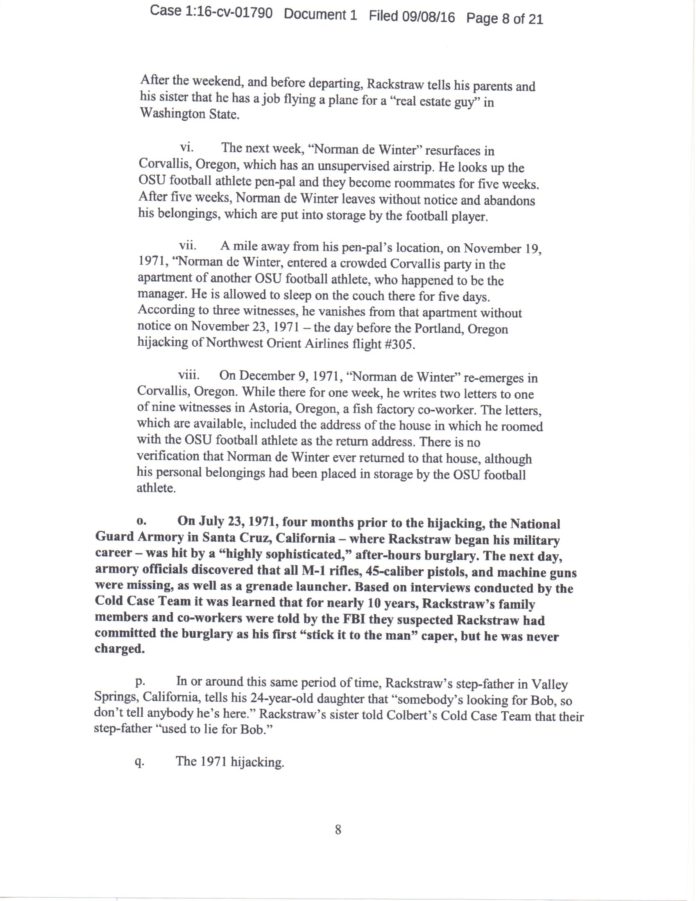
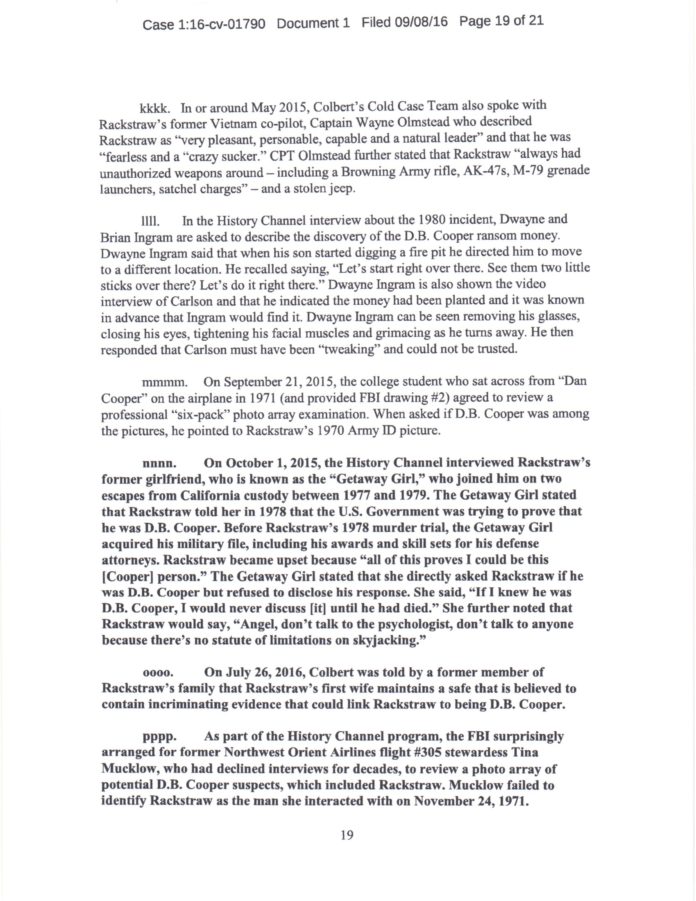
The investigation remained open until 11th July 2016 when the Federal Bureau of Investigation announced that it considered the case closed. However, a Cold Case Team sued for the release of the FBI Papers and found that there was evidence to link a certain Robert Rackstraw to the elusive D B Cooper. The entries in dark type constitute evidence not previously released to the public domain. Rackstraw had been disregarded as a person of interest decades before. Now aged 72, he is alive and well, living on the West Coast of the US. 

This is an extract of the evidence amassed in the Official Files which is fascinating for anyone interested in this unique and unsolved crime.

For those on mobile phones the small print is best viewed in the full web version- see link at the bottom of the page.


Friday, 11 August 2017

Poking at Cows

Astronaut, Cowboy, Train Driver. 

At age 12 they were my dream jobs for my grown up future working in descending order of preference and ambition. 

Being a baby-boomer I was very aware of the Space Race and the first Moon landing and I could from memory recite the names of the first few Apollo crews. In the playground I was always Jim Lovell. 

Third choice could not be farther away in terms of perceived peril, speed and working conditions but again, my childhood years were a time of great advances in railways and a train driver had a certain heroic appeal. 

As for the middle career option as a cowboy, well, given the certainty of just one of the three then I would be a cowboy. 

The film genre of Westerns was dominant in my childhood from Saturday morning TV with Champion the Wonder Horse and The Lone Ranger to the movie releases at the local Picture House. 

I was brought up on the performances of Widmark, Fonda, Ford, Stewart, Wayne and Lancaster and mimicked their stance, drawling voices and gun-slinging style out in the street on the middle class housing estate where we lived.

Brother, Mark, in his outfit
For quite a few weeks at a time I lived in my cowboy outfit purchased from the local toy shop with Stetson, waistcoat with Sheriffs badge, tassle edged plastic fronted trousers, red spotted neck tie, belt, holster and six shooter. Just wearing the outfit made me feel about ten feet tall. 

I did however have real doubts as to whether I would actually cut it as a cowboy if I chose to become a real one when fully grown. 

I was quite small for my age, thin and scrawny and so would obviously struggle to control a boisterous steed, let alone be able to climb up onto it in the first place if that physique persisted into my adult years. 

My movie inspired role model cowboys did fit a certain body shape and persona. Broad shouldered, chiselled chin just dusted with a designer stubble, handy with the fists and yet quick on the reflexes in order to outwit and out-draw those who would bring you down. 

I might be able to get somewhere near this idealistic cowboy shape through sensible diet and good exercise in my teenage and early adult years. 

Of course, the era was one where smoking was cool and sophisticated and so part of my cowboy impersonation aged 12 would include a packet of confectionery stick cigarettes or failing that, chewing on a piece of dried wood. I didn’t fancy the idea of being a smoker though and would have to develop a liking of hard liquor instead. I could not really understand why, after a long day in the saddle riding the range and corralling livestock, the first thing a cowboy would order in the saloon bar would be a whisky, hardly the thing to quench a parched and dust filled throat. 

A common trait for the movie portrayals of a western hero was strong and silent. This was essential in times of personal danger, crisis and where dealings with women were concerned. I was always very quick to blush from ear to ear if even a female relative said something to me and so I would expect to struggle with that sort of characteristic in my older years as well. 

Gambling was a primary pursuit of the traditional cowboy and developing a poker face would be an important thing when sat in a huddle around a card table in a very unhealthily smoky lounge bar. I was never any good at card games, not even Happy Family or Snap and so did not anticipate much joy and success with that particular aspect of the lifestyle. 

On the positive side I loved aged 12 and still do today, baked beans and I would fit in easily around the chuck wagon and camp fire. 

My membership of the Cub and Senior Scouts would help greatly in the practicalities of making up a fire, outdoors cooking and following a trail. 

I was as you can see wracked with doubts and anxieties about a future career as a cowboy. 

What gave me great reassurance as to my ambition was a song written by Larry Weiss that Glen Campbell released in 1975.

If the particular individual in the song could make it, being of comparative lightweight physique to me, then everything looked to be good for my own dreams and aspirations.


Unfortunately, I now realise that I had misheard some of the lyrics.

I've been walkin' these streets so long
Singin' the same old song
I know every crack in these dirty sidewalks of Broadway
Where hustle's the name of the game
And nice guys get washed away like the snow and the rain
There's been a load of compromisin'
On the road to my horizon
But I'm gonna be where the lights are shinin' on me

Like a nine-stone cowboy
Riding out on a horse in a star-spangled rodeo
Like a nine-stone cowboy
Getting cards and letters from people I don't even know
And offers comin' over the phone

Well, I really don't mind the rain
And a smile can hide all the pain
But you're down when you're ridin' the train
That's takin' the long way
And I dream of the things I'll do
With a subway token and a dollar tucked inside my shoe
There'll be a load of compromisin'
On the road to my horizon
But I'm gonna be where the lights are shinin' on me

Like a nine-stone cowboy
Riding out on a horse in a star-spangled rodeo
Nine-stone cowboy
Gettin' cards and letters from people I don't even know
And offers comin' over the phone

Like a nine-stone cowboy
Riding out on a horse in a star-spangled rodeo

Like a nine-stone cowboy
Gettin' card and letters from people I don't even know....


Apologies to Larry Weiss and the recently departed Glen Campbell for this.

Thursday, 10 August 2017

Up The Garden Path (Part 2)

To recap from Part 1 of “Up The Garden Path”, a seemingly throwaway comment by a very respected writer on the buildings of England set me a challenge. 
It is, at face value, an unfounded comment, a speculation and even the championing of a local rumour. 
I find this most out of character with the otherwise obsessively factual and no-nonsense reporting style by Pevsner which has established him as a foremost authority in his speciality. 
The sentence in question is, I quote, 
“A persistent local tradition attributes the design of the garden in 1840 to Joseph Paxton”. 
In context this is like someone finding an original music manuscript and claiming it to be by Mendelssohn, a transcript thought to be a work by Dickens or a painting by Rossetti.  
It may be possible to authenticate tangible and material masterpieces in literature and the arts with reference to Experts and precedent but not so for such a transitional thing as the domestic garden in this case. 
With such a prominent historical figure as Jospeh Paxton there is of course an abundance of biographical and reference material. I will not go into his C.V here. He is well worth a Google or Wiki Search but allow some time to wade through what was quite a remarkable lifetime of achievements. 
Compared to just a few years ago there is also a huge resource of information on-line which saves time, in contrast to having to spend hours in the local library or requesting information by e mail or in long hand letter requests. 
My own investigation into whether Joseph Paxton did indeed design the garden has been a bit unstructured. 
I have jumped about from link to link grasping at any mention of the key words and may easily have missed that Hallelujah moment of revelation of the truth. 
My main lines of enquiry have been centred on Paxton but also the specific village and its residents around the 1830’s and 40’s, the house in the garden and then spreading outwards in the local area, wider Yorkshire county and nationally. 
I have not yet found a definitive connection between the great man and the village or house. 
In the time of the alleged garden design the house was The Rectory and with a Reverend J Carter the incumbent. He appears to have been typical of the clergy of the era in having a privileged upbringing (a second or third son of gentry), and privately monied either by inheritance or marriage. 
A garden design commission by someone of the reputation of Joseph Paxton would be costly and unlikely to be a chargeable expense to Patrons or The Diocese. An ambitious Vicar or his lady wife would have to pay for such a luxury out of their own pocket. 
The garden is described as coniferous which was a pioneering speciality of Paxton under the term Pinetum whereby specimen trees were planted to emphasise their distinctive shape, form and foliage. 
The Parish Church was in the patronage of St Johns College, Oxford but my investigative trail goes no where along this particular direction. 
There is a good body of church documents in the public archives relating to maintenance and improvements to the Rectory but nothing relating to the garden and grounds. 
Paxton was a regular visitor to Yorkshire for both work and in his leisure pursuits. He has a strong association with the genteel seaside town of Scarborough and in the late 1850’s designed and built the Spa Complex and gardens which largely survive today in spite of partial destruction by fire in 1876. 
He is likely to have had earlier contacts in the wider Yorkshire region from his architectural and landscaping projects. 
Under one biographers' description of Paxton as “The busiest man in England” he certainly got around to a lot of areas of the country. He distinguished himself with the ‘Great Stove’ conservatory at Chatsworth, built between 1836 and 1840, which was the largest glass building in the world at that time. Subsequently, he designed the biggest glass-house in Europe, made up entirely using sheet-glass. His most celebrated work was of course the Crystal Palace for the 1851 Great Exhibition. 
Broadly corresponding to the time of the garden design in question (1840) Paxton was down in Derbyshire on a major commission to create, on a virgin site, the village of Edensor (pronounced Ensor) near Chatsworth. He also worked on public parks in Liverpool, Glasgow and Halifax. 
Paxton was also an astute investor and made, for the time, a small fortune by speculating on the new opportunities in the railways. I did work on a theory that he may, during a long rail journey to Scarborough have stopped off or got stranded in the village and either on a paid or philanthropic basis then modelled the Rectory garden. However, this fanciful idea falls apart as the railways in this part of Yorkshire were not built until after 1840.
The village is on a busy road route from the West Riding to the Yorkshire Coast and Paxton may have known about it from his travels by coach and horses.
There is a rather vague reference that during the 1840's, he continued to work on landscape gardening and designed various country houses and other domestic buildings. 
Could this have included the Rectory Garden? …. To be continued

Wednesday, 9 August 2017

Up the Garden Path (Part 1)

I like a bit of a trail. 

It usually starts with a snippet of information or a subject that catches my imagination. 

This could a paragraph in a newspaper or magazine, a blue heritage plaque on a wall, the name of someone I have never heard of before or something from deep in my own memory bank. 

All of these strands have provided the source and inspiration for my daily blog ramblings over what is now approaching 6 years continuous (give or take and with some re-issues if I am tired or busy). 

I continue to be excited by such discoveries and in the anticipation of where they might lead me. 

So, you can appreciate the stirring of my curiosity from coming across a strangely worded and vague sentence in one of my frequently consulted books, the thick volume on The Buildings of England covering York and the East Riding by Nikolaus Pevsner (1972). 

I nearly skipped over the throwaway line during a quick scan of the entries for a small rural village in pursuit of the details on a specific house, the former Rectory which a family member had just visited. 

She had been enthused by the place and as usual my Pevsner, whereas others are similarly drawn to Baedeckers or Bradshaw, was hauled off its shelf in an attempt to impress her with further facts. 

The sentence worthy, in my mind, of investigation read;

“A persistent local tradition attributes the design of the garden in the 1840’s to Joseph Paxton”. 

I am not sure what actually constitutes a “persistent local tradition”. 

It sounds almost maniacal or fringing on criminality as in a tendency for the villagers to regularly throw stones at strangers in the vicinity or in the context of the rest of the sentence there may be some suggestion that the residents are habitual fibbers. 

However, the most important part of the sentence is in the name, Joseph Paxton, or to give him his full title, Sir Joseph Paxton. 

In the Victorian era he was everywhere. A leading book about Paxton describes him as “The busiest man in England”.

Self made Landscape Gardener, Architect, Member of Parliament and shrewd Investor are amongst his main personal accomplishments but three of his principal projects elevated him to celebrity status in his time.

These were the setting out of the palatial gardens at Chatsworth House in Derbyshire, the design of the Crystal Palace for the Great Exhibition of 1851 and the cultivation of the world’s most popular species of banana. 

There would be significant reflected glory for a small village if one of its handful of properties had a validated link with this most famous of personalities. 

My own attempts to confirm this claim have so far drawn a blank. 

As is a common phrase I have been led up the garden path. 

Short of confronting those in the village with any archived solid proof, as in an authenticated blueprint of the design, monogrammed trowel or etched graffiti on a wall my own enquiries through multiple and authoritative routes has drawn a complete blank. 

I really would like to think that the link is a true one, capable of provenance. I hope that it is not a fiction concocted by certain members of the 1840's village population as some sort of attempt at extracting cash from those who made a leisure activity out of visiting the sites and vistas created by Joseph Paxton.......( to be continued).

Tuesday, 8 August 2017

On the Richter Scale

Christian Richter spent his teens exploring abandoned buildings in what was then Communist East Germany. It was a wondrous playground although a sad reflection of the decline of a nation. In adulthood  he is still drawn to these and many other sites  but now he takes a camera to capture the advancing decay of their interiors.

Christian was 14 years old when the Berlin Wall came down. He experienced first hand the huge change for everyone.

"People didn't know how it would all turn out. It was very exciting - the start of something new. At first we visited the West a lot just to see what it was like, and although quite a few people moved away, I stayed"

It was inevitable that with so many people leaving  everything from infrastructure to buildings began to fall into disrepair. That's when Christian started visiting abandoned buildings, sometimes with friends and sometimes on his own. Then much later, when a friend gave him a digital camera, he was able to capture the beauty of these old places.

He has a great eye and appreciation for the decaying structures

"They are very peaceful places because no-one ever goes there. The way they deteriorate, when nature starts to take over, reminds me that everything is transient. There's a feeling that it is the end of time and you don't find that kind of atmosphere anywhere else. Over the past seven or eight years I must have visited about 1,000 buildings in Germany, France, Belgium, Italy and Poland. I have to go to a lot of places to get one good image or find something that excites me - many of them are just empty and not particularly beautiful"

Getting into a building to take the haunting photographs put Christian in peril and also potentially at risk from arrest by the authorities.

"I've had to find tunnels or climb through windows. I've travelled long distances to see a building and then found it's been torn down, or I simply couldn't get in. Sometimes I can tell there might be something special inside, but it's more like a game of chance - maybe I'll find something, maybe I won't. At some point I may hit the jackpot but there's a lot of work behind it - it's very hard to find this kind of beauty"

He once got a tip-off about an old doctor's surgery and it was plain to see that he was the first person to go inside for perhaps 10 or 15 years.  Such a place had returned to nature with cobwebs giving a rather  mystical appearance  like going back in time. The way the light streamed in contributed to an amazing atmosphere.

Other buildings offering themselves to Richter's art included former industrial plants which had simply fallen into ruin, and psychiatric hospitals which had been closed down. There is no-one taking responsibility for  them and certainly no money for their upkeep . It  would not be viable economically or practically to preserve them.

"When the roof is falling apart and water comes through the ceilings, moss and lichen grow. If the windows that are not smashed are closed it can get very warm in summer and plants start to take over. Often there's a very mouldy smell, but I like it when nature starts taking the building back, and when things are blooming and growing inside"

When Christian comes across an old building in this state his skill is in imagining it in its former glory but there is tragedy in the knowledge that the majority have no prospect of ever being used again. Christian knows that it is of the utmost importance to keep the locations secret. This is  to stop vandals damaging them  because some people do not value them and when they get inside it is not just the plants taking over, but unfortunately it is people who are tearing down the bannisters or spraying graffiti tags on the walls.

Christian has his heart amongst these dinosaurs of former Eastern Bloc cities, towns and villages.

"If someone wanted to restore a building, they could write to me and if I thought they were actually the kind of person who might genuinely do something to help, then of course I would try put them in touch with the right people. That would be theoretically possible, but it hasn't happened yet"

"I never break in - I always try to find a way to get inside that doesn't involve damaging anything. That might mean going through a hole in the cellar, over a fence, through cracks, through a window - there's a lot of climbing involved. It's hard work and I have to be quite fit. Some buildings are so tightly secured that you have to be a real climber in order to get in without breaking anything"

There is a value in the art form created but it should not be forgotten that it remains illegal to go into these places. On many occasions Christian has been stopped by police , escorted out of buildings at least two or three times and issued with a notice. It has been more luck than anything that the authorities have never pressed any charges. Just taking photos and not showing any signs of being equipped to steal or vandalise has been a passport to being left free to wander in many situations.

"Some of these places are very atmospheric, very moody. I once photographed a former crematorium where bodies had been burned. It made a deep impression on me. Another time, I found a beautiful room with a skylight in an abandoned five-star hotel. I think it was a dining room - I could see the old columns and the dirt on the crumbling floor, and this enormous skylight was covered in curtains, and the light was spilling into the whole room. Then there was an old public bath, possibly built in the 19th Century, with the original changing rooms, magnificent columns and stucco on the ceiling, and of course a big pool in the middle, without water - but on the walls there were the beautiful colours they used back then, yellows and reds, big contrasts. It was really stunning"

The real beauty as Christian extols is in discovering these places. He states that the photos aren't exactly secondary but they come alongside the discovery itself. He takes the photos to give other people a sense of what used to exist.

"I think people the old buildings for the same reasons I do - there is beauty and sadness mixed up. I think people can identify with the fact that even if you have a wonderful, big house right now, at some point everything will decay. Even palaces and villas are transient"

See for yourself.


 Photo used with kind permission of Christian Richter
 
    (Interview originally with BBC World Service. November 2015)