Monday, 28 August 2023

Hull Man to solve UK Housing Crisis (1925)

The current housing shortage crisis in the UK is nothing new. 

It is widely stated by activists and charitable housing organisations that there has been a systematic failure by successive governments over the last 40 years to come up with a committed and adequately funded policy to keep the population housed. 

In fact, the lack of a housing strategy goes back much further. 

There were good and laudable intentions after the First World War in the “Homes for Heroes” initiative and yes, some progressive and sustainable developments were taken through to completion and habitation. 

The actual numbers and locations however fell woefully short against actual need. We have, in this country, been on catch-up ever since. 

A prominent name in the mix to address the national housing shortage in the 1920’s was the Hull based, Robert Greenwood Tarran. 

He had seen a shortage in his home city alone of around 10000 homes and in 1925 he built, on Lorraine Street in the Stoneferry Area of East Hull, a pair of his Tarran build concrete houses for inspection and scrutiny by the Hull Corporation Housing Officials as well as inviting other Authorities and National Institutions. 

Other systems built houses were of course available and around the same time the Ministry of Health had been party to a demonstration of a Lord Weir Steel House. 

Robert Tarran had complete faith and confidence in his reinforced interlocking concrete block or panel method of house construction. 

His biggest obstacle was to persuade the Local Authorities but also the General Public that his methods and materials were as sound and durable as bricks and mortar. 

There was a strong resistance to the idea of anything other than traditional build and Tarran would have to work hard to achieve publicity and interest in his non traditional houses. There were also the equally important factors of cost and speed of building as in the years after the First World War there was a significant shortage of materials and skilled labour 

Tarran demonstrated that his houses could be built in just 28 days and with mainly unskilled labour. The key to his method was the casting of the concrete panels in moulds as a cheap and rapid factory based process. With suitable round iron reinforcement the panels came in 6 feet by 2 foot 9 inch units and with a 3 inch thickness. These were inserted into a timber or metal framework erected on a cast concrete base and under a pre-positioned up and over roof. 

Robert Tarran knew that, in order to win over the preconceived ideas of the authorities and the public, the finished product had to look like a standard house and not like a shed or outbuilding. The external finish was rendered, typically in smooth or pebble dash. Issues of inevitable sweating and condensation in the concrete components were countered by a good ventilation system which was an advancement of its type. 

Tarran was able to give an orthodox appearance to the house, a stable, rigid and weatherproof structure and a conventional floor plan. These attributes meant the houses could be regarded as permanent structures and would therefore be suitable to meet Government Funding Criteria for a 60 year loan. 

Two types were available, both of 3 bedrooms (at a time when older traditional brick houses in Hull were predominantly of just 2 bedrooms) and up to date amenities. The one living room version had a £425 cost in a ready to occupy condition and for £500 a parlour or second living room was available.


Tarran claimed that he could build 1000 of his houses over a 3 to 4 year period and would donate four homes for free to The Great War Trust. 

Housing Experts at that time were of the opinion that Tarran's houses exceeded any previous systems in replicating the expectations and public acceptability of a traditional bricks and mortar dwelling.

As a footnote, Tarran was well ahead of his time in the 1920's and although his company Tarran Industries were also Civil Engineers and prominent in major building projects in Hull in the pre war and inter war era it was not until the 1940's and beyond that his Concrete Houses came into their halcyon era. In all and on a National Basis Tarran built around 19000 houses. 

Tarran variant house types are still standing today but only where significant repair schemes to combat the corrosion and weakening of the metal reinforcement in the concrete panels and framing have been carried out. 


                                                Photograph of a post war era Tarran bungalow

The repatriation of Trump (The Goldfish - not the other)

I wrote this a few years ago now on the subject of the two goldfish that comprise the current official menagerie of our family, (Excluding the local wildlife of squirrels, magpies, pigeons and urban foxes) It is particularly relevant and not a little bit poignant because one of them died and the other is shortly to be repatriated to the Aquarium Shop as we are no longer able to keep him. The reasons are complicated. 

Here goes....

Having written the foregoing I am somewhat ashamed to admit that my two goldfish, constant companions to me in my work-room over the last 3 years remain without any names whatsoever.

I can explain this, partly, in that they were acquired as participants in the Iranian New Year Festival in 2015.

Amongst various symbols of renewal and tradition for Nowruz the fish represented life and creation as they swam around the glass bowl on a ceremonial table. I fully expected our Iranian friend to claim ownership of the fish and take them with him but no. It appears that after the New Year in Iranian Families the symbolic goldfish have served their purpose and just disappear. 

So, a few years further on and they are just behind where I sit at my desk, although in a much larger tank. The bubble and murmur of the filter and pump are hardly noticeable to me now although from time to time the fish flick the surface with their tales to disturb my concentration. This is usually as feeding time approaches or if they require a staring match through the thick glass of the tank which they seem to enjoy doing.

As for giving them names, well, I am pretty close to doing that with the catalyst being something that the pair of them have recently done within the few cubic feet of their environment.

It is only in the last week or so that, unbeknown to me and very much behind my back (actually behind where I sit) they have undertaken a large civil engineering project.

Half of the floor area of the tank is now exposed glass, devoid of any gravel or objects. In a painstakingly slow process by mouth or fin the two fish have created a sloping shelf or underwater beach from the small aggregate stones and pebbles that runs from the middle of the tank all of the way up to the outfall of the pump/filter.

Apparently this behaviour is quite normal for goldfish but in this case normal is not a word I would use.

The creation is geologically and topographically perfect over its 30 degree slope. In addition some sizeable stones which were collected during family holidays and excursions for their unusual shape and texture have been manoeuvred into very natural looking positions within and at the foot of the gradient.

This will have been no small feat given their density and ,what I had thought, immovability. 

I have been so engrossed in my own work that this major redevelopment scheme has gone unnoticed for so long. 

I cannot say which of the fish has assumed the roles of architect, designer, project manager and general labourer although they are very different in size and manner being from two distinct breeds

I can imagine that the larger of the two, a chubby, bossy and belligerent classical Carp shaped fish would be the instigator and the much smaller, delicate and flowing tailed one a bit of a fawning acolyte.

Yes, the fat fish is very bright orange, quite flamboyant and self assured and yet not in possession of the sharpest mind. His companion is subservient but I suspect very clever and a little bit devious in appearing to go along with the whims and fancies of the dominant partner and by doing so getting exactly what it wants.


I can therefore have the naming ceremony here and now.

The pair of fish will henceforth be called Trump and Kush.

There is some satisfaction in having reached this point but I am now a little bit concerned about what the outcome of the further fish tank based activities of Trump and Kush might be- a golf course, a wall or as a launch pad for aggression and mayhem in their own little world...............................................or beyond.

Thursday, 3 August 2023

St Swithin and Soggy shoes

It has been the wettest July in the UK since records were made on such things. As Brits we complain but at the same time do not wish upon ourselves the other weather extreme being visited upon other parts of the world in heatwaves, wild fires, floods and drought. Here's a bit of a musing on water..... 


The following is an edited transcript of a BBC 4 extra radio play that aired some time ago now. The work, entitled "The State of Water" is a drama around a Welsh Hill farming family and the decisions they have to make to conserve the natural water resources on their land. 

The writer, Sarah Woods blends language and emotions with a factual thread which taps into the whole theme of water supplies and security which are becoming a significant consideration across the globe.

"Each of us is made up of 60% of water.

It is in our blood, heart, arteries, veins and capillaries.

It conducts the electrical signals in our brains to allow us to function. Water lubricates our joints, allows eyes to turn in their sockets, dissolves enzymes and hormones and carries amino acids, carbohydrates and minerals, carbon dioxide and electrolytes.

Of the 150 litres that each of us uses every day we drink only 6 litres. Some 50 litres is used in showers and spills from taps. 20 litres run through the washing machine, 45 litres are flushed down the toilet. The rest just drips away as we wash foodstuffs at the sink or brush our teeth.

We rely on water to produce just about everything in our lives.

A single tomato from seed to sandwich filling uses 13 litres of water. A hamburger from grazing pasture to the inside of a sesame seed bun takes 2400 litres. A pair of leather shoes is a consumer of 8000 litres and the production of a car, 400000 litres.

A sip of tea contains 136 drops of Indian water, the equivalent sip of coffee 1100 Brazilian drops. The perfect accompaniment for a roast dinner, potatoes were irrigated in Egypt. A refreshing orange comes from Spain and other citrus fruits from the sun drenched eastern Mediterranean.

Water surrounds particles and puts them in solution.

There are organic compounds from decaying plants, crypto spiridium from animal faeces, pesticides from the fields seep into the water in the absence of filtering peat and soils, slurry leaks into the watercourses and strangles the oxygen which asphyxiates the fish, over-use of fertilisers encourages a poisonous algae bloom, industrial processes leach iron, aluminium, tin, lead and cadmium into the water and this is joined by other toxic waste from car oil to rubbish tips, pollutants from cooling water as it is returned and heavy metals from panel beaters, dentists and university laboratories.

The solution bio-accumulates in our bodies and bones. The contraceptive pill and HRT put oestrogen into the water. Raindrops, thick and heavy with particulates from the burning of fossil fuels absorb Carbon and Nitrogen dioxides resulting in sulphuric and nitric acid. This increases as more rain releases aluminium and metals which kills insects and the wildlife that feed on them.

As the earth warms up ,water vapour fills the air. Summers around the globe and the natural aquifers become drier and as this happens there are greater demands for water.

Glaciers melt which causes problems for the 1 in 6 of the population who rely on meltwater. Sea level rises from glacial melt meaning that saltwater overwhelms freshwater supplies.

Downpours are more severe and concentrated and yet as half of the world suffers from devastating floods, the other withers from punishing drought.

Water is a finite resource and yet we take it for granted. Seagoing tankers take 36 million litres of freshwater from France to 330000 homes in Spain whose residents are in water crisis. 

There is no more and no less of it. We drink the water that our ancestors bathed in .

There is nothing to replace it with when it is gone."

Tuesday, 1 August 2023

Kick it Hard Lily

The second highest career goal scoring record behind Pele is from a much lesser known player whose games were played over the years 1920 to 1951.


Lily Parr's total of over 1000 goals is remarkable enough an achievement but even more so given the turbulence of the times which covered the implications and complications of two world wars, a major economic depression between and the emotive political and social events for the acceptance of women in the male dominated world of just about everything.

The mass and necessary recruitment of women as a labour force to cover for the conscripted male workers into the first world war drew the attention of the Government to the wider health and welfare issues of women. 

A healthy and happy workforce were a productive and less troublesome and potentially militant group.

The Preston, Lancashire based manufacturers Dick, Kerr and Company had been established in 1900 specialising in the tram and light railway sector but switched to essential war work in 1915 making munitions.. 

The factory employed a predominantly female staff on the production lines and within the remit of keeping key workers fit and healthy a football team was formed taking the company name.


Rival industrial and manufacturing companies also former their own teams and around 150 were registered within what became a very competitive league structure. 

The Munitions Cup, played for in 1917, by the Munitionettes as a wider descriptive term for the participating ladies teams was watched by a crowd of 10,000 at the ground of the great mens team of that era, Preston North End. The crowd attending raised £600 for wounded soldiers.

The ladies game was not confined to the war years and by the early 1920's it was well established and experiencing its halcyon days. 

The Dick, Kerr Ladies were prominent and played 60 competitive matches during the 1921 season in front of an aggregate attendance of 900,000. A crowd of 53,000 was present at Goodison Park in Liverpool to watch the Dick, Kerr Ladies beat close rivals St Helens Ladies.

The success and genuine support for the ladies league caused grave concern amongst the crusty old Football League administrators and in a calculated but spiteful move they issued a ban on the use of any League grounds for the playing of ladies matches. 

In their expert evidence to support the ban various medical practitioners were produced to express concern over what dangerous impact playing football could have on fertility and femininity. 

The ban remained in place until 1971.

The Dick, Kerr Ladies continued to flourish and amongst their honours were multiple league titles, International victories including tours to France and the USA and reaching a pinnacle in 1937 becoming World Champions. 

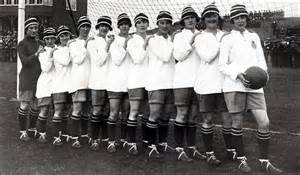
Against the well entrenched establishment and remnants of the austerity of the Victorians which still dominated society and attitudes the team were the first in the women's game to wear shorts. 

Archive photographs of the team resemble a line up of dancing girls, nimble,graceful and lithe but wearing heavy leather football boots and with a bit of a sun tan. The team fell out with the bosses over some undefined 'tut-trouble at factory' and reformed as Preston Ladies until 1965.

The significance of the achievements of the Dick, Kerr Ladies cannot be understated. 

They were brave pioneers at a time when women had no real voice in politics or society. They rose above the petty and what would always be temporary concessions required by the circumstances of the first world war and continued to excel and attract a very good following and fan base through the heady days of the 1920's. 

The names of Lily Parr, Florrie Redford and Alice Kell amongst all of the players have tended to be forgotten apart from dedicated archivists who maintain an excellent web based resource. The stars of the team were inducted into the Football League Hall of Fame but as a gesture it was too late and a bit patronising.

Lily Parr was challenged by a male goalkeeper to try to score a spot-kick past him. He had observed her obvious footballing skill and ability, in particular her reputed very hard shot, but was under the impression that it only looked to be a hard kick in the company of other women team mates. 

Taking up the challenge Lily was seen to smile when the unfortunate chauvinistic keeper was taken off to hospital with a broken arm from the impact of her penalty kick.

Friday, 28 July 2023

Retrospective. 2019 Women's World Cup Finals

Just a bit of a reflection of mine from the last Women's World Cup in anticipation of the current 2023 Tournament  

I am sad that the TV coverage of the FIFA Women's World Cup has finished.


What a tremendous festival of football it has been over the last few weeks.

It has been hard to schedule in the televised games amongst family, work and social commitments but I can say that I have seen a very high proportion of them.

I am a keen follower of a lot of sports regardless of gender but the Women's World Cup has challenged my preconceived ideas and male prejudices far beyond what I would have expected.

Yes, my sexist and misogynistic hard wiring as a man has on occasion threatened to take over but I feel admonished to a degree in that I have been able to recognise the signs at an early stage.

I have not allowed these inherent traits to diminish in any respect the athleticism, skill, endurance and tactical prowess of the players.

I was a curious onlooker to start off with.

The emergence and increasing profile of Women's Football has awoken many to its level of performance. It has been a hard struggle to gain the recognition and attract the financial backing even in a sport where, in the Men's game we are ever more astounded by the wages and excesses although such things are very much regarded as the norm.

The historical background of women's participation in football is quite shameful in that a previous halcyon era in the inter war years in the UK was vindictively ended by the dark suited old men of the Football Association who imposed a ban on women's matches being played in the grounds of its League members.

This was in spite of mass popular support and huge attendances which propelled the likes of Lily Parr into a glorious, albeit short lived stardom.

Some years ago my eldest daughter trained with a local Under 12's male youth team but her obvious affinity for the game was always stifled when she was relegated to play with the "C" or "D" team when she should have been a regular First Team selection.

It was the case that Dads and Lads ruled the day and girls were kept in their place.

Some 17 years later she did get to play in a Women's League but I just think about all of those wasted years brought about as a direct consequence of male chauvinism, backward thinking and entrenched ideas.

At least young girls and women will benefit from the high profile attained by the current status of the game and get so many more opportunities where before that was obstructed and hindered.

Sunday, 23 July 2023

Lookout Look Up

In the course of my daily work of Surveying houses I come across some very individual and quirky places. 

That was the case just a couple of days ago in a small seaside town on the North Sea Coast in East Yorkshire. 

I am a bit embarrassed to admit that even after some 30 years of driving down that particular street I have failed to notice the rather strangely styled structure atop a pair of properties. It is a timber clad lookout tower. 

This photograph, although rather grainy with age shows the tower- see upper mid left.


The two houses well predate any other residences on the street and indeed are somewhat grander in style and in the use of materials than their neighbours. 

Under the name Eton House the three storey houses are likely to have been built for a single family occupation covering multiple generations or even with the original intention of the builder to sell off one of them for a profit and keeping the best for their own occupation. 

The Title Deed indicates a sale of the land followed by construction around 1882. 

Given the quality of the brick and the glazed clay embellishments at the eaves (corbelling) and above the windows and front door there was no expense spared within the commission. This is indicative of local wealth and influence of the intended occupiers. The lookout tower may have been part of the original build and with its unrestricted views to the sea could be associated with the owner of a seagoing vessel such as a fishing boat or inshore cargo carrier. 

The seaside town itself does not have a harbour and the Pleasure Pier was never reinstated after a storm stricken ship collided with and severed the otherwise illustrious and well patronised attraction. 

This would mean a mooring of a larger vessel out at sea and the need for an owner or operator to keep a regular vigil. 

What better than your own high level observation point? 

The tower, today, remains in good condition although as the pair of properties have come into separate and unrelated ownership so there has been a compulsion to sub divide it and rather than a large panoramic outlook there are now two 180 degree aspects. 

The maintenance of the old timber frame will form a liability on respective owners but because of the local historic significance this has been carried out sympathetically and diligently by successive owners. 

The side relevant to my Survey is internally ship lap boarded and retains small leaded and stained glass  windows. It was perfectly dry and well preserved. 

As for access, this was from the attic level of the house with a steeply angled ladder and a liftable trap hatch very much akin to that between decks on a ship. 


Speaking to the current owner she told a story, told in turn by someone else to her about a fatal suicide from the lookout tower way back in the history of the house. 

It was recounted that the reason for the suicide had been the death by drowning in the backyard well by a young child and with the grief and guilt ridden parent taking their own life. 

This story really caught my imagination and I felt compelled to research it further. 

In the depths of the British Newspaper Archive I found the following story which broadly fitted the date and background story. 


This is from the Eastern Counties Press Newspaper in 1897. 

If you can make out the text it appears to give a happy ending to the much told local story 

Friday, 14 July 2023

A Game of One Half

16th February 2018. Another excursion to The Smoke by my home town team, Hull City for the Fifth Round FA Cup against Chelsea.

Games in the Capital in respective League and Cup matches have never proven fruitful apart from the remarkable victories in The Tigers first Premiership Season away to Spurs and then ending a stella Home Win Record for Arsenal at the Emirates including a wonder goal the Brazilian, Giovanni.

There was of course the 2014 FA Cup Final with City forcing extra time before eventually capitulating to the Gunners from a 2-0 lightning start. I made the journey to Wembley that year with a car full of family and friends. It was a rare chance for me to attend an actual match.

I am of the generation brought up on radio broadcasts of football and have so far resisted the lure of Pay to View or high cost subscriptions to Mega Media.

I have experienced great and iconic moments in radio commentary over the years listened to via my parent’s wardrobe sized overheated valve set, my teenage years portable transistor and latterly a high tech digital radio.

Many an afternoon and evening has been spent in the company of the likes of Peter Jones, John Motson, Alan Parry and the latter career years of Kenneth Wolstenholme. The combination of sheer knowledge about the game , tone of voice and delivery are rarely matched today.

So, I was prepared for the BBC Five Live Coverage from Stamford Bridge with all of the usual hopes, fears and anxieties even for an armchair supporter of Hull City.

By way of background, my team in early 2018 were in a very different and somewhat darker situation to the Premier League Yo-Yo and Cup Finalist eras.

There had been the usual Second Tier Owner/Chairman issues with a Fan boycott. The Managerial comings and goings included a former Russian National Team Coach to stalwart lower league journeymen. The team were just one point clear of the Championship Relegation places in the last quarter of the season.

The Chelsea game was a welcome distraction and in the previous Cup Rounds Hull City had shown excellent form beating Blackburn Rovers and Nottingham Forest who themselves had knocked out Arsenal.

The selection for BBC Radio Commentary was to be regarded as prestigious and much anticipated with the prospect of a possibly competitive contest and as always the chance of a cup upset.

Nigel Adkins, the City Manager had his game plan. It would be a necessary scenario to hold out for as long as possible and hope for a counter attack.

Unfortunately the game plan went out of the window with a second minute goal by Willian to be followed by three more Chelsea goals before 42 minutes.

Hull City were always better in the second half of a game and the status of being thrashed at 4-0 would hopefully not get worse.

At that point on half time the BBC inexplicably broke off from the commentary and switched to Leicester City v Sheffield United at 0-0..

This was unprecedented BBC behaviour in all of my 50 plus years of listening to radio coverage of football.

I could only stare at the LCD display on my radio in utter disbelief and indignation. I am not one to bear a grudge but the BBC’s decision to move away from the live commentary left me stunned and angry. Yes, Hull City apparently improved slightly after the break and even had a penalty saved by Caballero. I would like to have heard about that first hand. The match statistics showed 45% City possession and in fact a better shots on target percentage than Chelsea even with the 4 first half goals taken into account.

I have regularly returned to the emotions stirred by the Game of One Half.

My sense of bereavement at the loss of the second 45 minutes was raw and very real and I required some form of closure. It was not important that it took me 5 years to act.

The BBC is a State Broadcaster and subject to the Freedom of Information Act.

I wrote to their Information Rights Department seeking an explanation. They said they were happy to voluntarily provide a response which was “It is not uncommon for 5 Live to move between different cup ties depending on the state of play and potential levels of excitement for the broadcast audience”.

I am not aware that the BBC have repeated their abandonment of a match commentary at half time in the intervening 5 years to the present or indeed ever or in any competition. In fact the Leicester V Sheffield United commentary straddled both 5 Live and 5 Live Extra and so the BBC defence was weak and not entirely true.

I cannot help but to constantly re-live the emotions stirred by the Game of One Half.

I have tried to avoid the usual speculation about conspiracy theories, the unprecedented bias of a London centric media against any North of England teams and attempts by the BBC to trim their budgets in their outside broadcasts.

In my mind the Game of One Half will go down as one of the great mysteries of human existence which includes the Bermuda Triangle, the whereabouts of Shergar, the purpose of Love Island and how Boris Johnson got to become Prime Minister.