Monday, 11 February 2019

English Lesson 4

One of the many radio re-runs that I find myself laughing out aloud to is "I'm Sorry I haven't a Clue" which is a very long running improvisational comedy show which over its many decades has featured the very best in comedic and entertainment talent.

A regular feature in the show is the offering by the participants of definitions of words towards the Uxbridge English Dictionary.

For any student of the English Language this must be most confusing as although the donor word is a bona fide one the meaning as described is only intended to elicit laughter or gasps of shock and awe.

The letter D featured here has a heavy Welsh influence for which I can only apologise.

Here is a bit of a compilation of definitions either broadcast since its launch in 1972 or just held in a remarkable database produced by Kevin Hale, undoubtedly the greatest fan and authority on the subject.

The list is in no particular order; (see earlier lists under English Lesson 1, 2 and 3)

Dictator- a humourously shaped root vegetable

Disconsolate- definitely a particular Embassy

Disappear- to insult a member of the Upper House of Parliament

Dunderhead- what a sculptor says after he's completed the top of a bust

Dilate- live long

Dipthong- washing a flimsy undergarment

Dentist- a man who repairs damaged cars

Dissident- a foreigner pointing out the damage to your car

Disguise- pointing at the foreigner who is pointing out the damage to your car

Dilatory- how to make contact with a member of the Conservative Party

Doughnut- eccentric millionnaire

Dragnet- stockings for men

Delight- turn off at the wall switch

Dogma- a bitch

Diptheria- someone who is an expert on recessions

Diversion- translation into Welsh

Direction- an aroused Welshman

Drawback- problems associated with those who are not circumcised

Dyspepsia- Coca Cola is easily the best over other soft drinks

Direct- a destructive Welshman

Delectable- Teresa May on current performance

Derelict- erotic experience in Northern Irish City

Dandelion- a big camp cat

Defunct- losing your sense of rhythm

Deserted- someone stole the pudding

Domineering- an earing shaped like a domino

Decease- to stop stopping

Dover Sole- Kentish music

Dossier- a French tramp

Digression- Welsh fighting talk

Donation- the place where Homer Simpson is King

Damnation- Holland

Disdain- to be rude to a native of Copenhagen

Debasement- de room under de ground floor of de house

Deft- ebsolutely med

Demistifier- a retired magician

Diffident- novelty toothpaste

Discount- pointing out a member of the nobility

Dodo- a repeat of The Simpsons

Dukedom- birth control for aristocrats

Dubai- Debbie from Birmingham

Decrease- doing the ironing

Diversity- a Welsh seat of learning

Doodlebug- sketching an insect

Dynamite- taking a flea out for lunch

Defuse- a safety measure in de plug

Doldrum- entertainer of a queue at the Department of Social Security

Dismiss- being rude to a female teacher

Dialog- a very poor piece of wood

Demister- castration tool

Delaware- to have seen a episode of Only Fools and Horses

Dunstable - to have shaved

Dumbstruck- hit by a man in a white van

Disgruntled- a pig with a sore throat

Disarray- giving directions in China

Ditto- one of the Marx Brothers fired for being too "samey"

Downloads- description of share prices in a post-Brexit Britain

Sunday, 10 February 2019

Silly Season

I have a new favourite joke.

This prestigious award which also covers funny events and hilarious behaviour does not really mean a lot because I find a lot of things funny on a daily basis and the current holder of this accolade could as easily be knocked off top spot in a matter of minutes.

Just today there has been a strong contender.

Take the sporting news that a competitive football match in Scotland has had to be abandoned during play because of the weather. Such has been the strength of the wind that a goalkeeper taking a kick out of his penalty box saw the ball go out, up and then shoot back behind him, over the dead ball line and out for a corner for the opposition.

That must have been incredulous to see.

Other sources of humour can be at the expense of others either through a combination of freakish events or just downright stupidity.

I do not really enjoy having to stifle a laugh in such circumstances.

Anyway, back to my new favourite joke.

I did hear it first a couple of years ago and it justified a giggle but not enough to oust "What is the secret of good comedy. timing" which as all my family and friends know is my regular fallback favourite and suitable for all occasions on the grounds that it is not rude, aggressive, controversial or sexist.

The pretender to the throne of jokes is similarly neutral although it does touch on aspects of education, teenage delinquency, the threat of violence and with a social comment on peer pressure.

No, not really.

I may be reading too much into what is just a joke, nothing more, nothing less.

Here it is. I accept that I may have inadvertently heightened your expectations but just go with it.

What did the inflatable Headmaster say to the inflatable boy who took a pen to the inflatable school?

"You've let me down, you've let the school down but worst of all you've let yourself down"

Silly but really, really funny.


Saturday, 9 February 2019

Toilet Humour

Whatever the status, wealth or privilege of an individual we all share a common denominator- that being we all have the same bodily functions.

I was thinking about this, as you do, when looking over an old City Map from the mid 19th Century. In an area now a large commercial district but at the time of survey on the edge of the main built up city the words "Muck Garth" stood out as being a bit unusual.

From further investigation of the archives this described an area of open ground.possibly a bit soggy and marshy which was used for the depositing of  human excrement which, in the era before proper sanitation, will have accumulated in chamber pots and other receptacles in readiness for collection by those employed in the rather unpleasant manual sewage and effluent industry.

A man with a cart will have been busy in the early hours of every morning doing his rounds and then, with a full load, making his way out to the dumping grounds.

This represented a major leap forward in public health as prior to this innovation the night soils of townsfolk and city dwellers will have simply been tipped out of the window onto the street or any unfortunate passers by.

This new role of "pooh" Operative will of course have been a chargeable service either at the point of collection or in the selling on of the waste to whosoever owned the land on which "Muck Garth" was located.

Prior to scientific advances in plant fertilisation and the availability of fertilisers this function was taken by human waste with all of its minerals, vitamins and nutrients in waste product form.

Incidentally, the functional Muck Garth would in the 20th Century be the site for a small housing estate including a cul de sac called Strawberry Fields alluding to the excellent growing conditions from rich and nutritious earth. This in my thinking supports the use of human fertiliser as a very natural way of recycling.

Going further back in history the place was very much more compact with none of the sprawl of residential suburbs or out of town amenities that have been a characteristic of our modern living environments although arguably not always for the best.

In fact, in far more uncertain times in history than the relatively civilised 1800's many of our towns and cities were within defensive walls or otherwise protected by natural features such as rivers and terrain from what must have felt like a constant threat or perception of peril amongst the population from invasion, civil strife, disease or just good old uncertainty about the future.


The nucleus of many of the older UK settlements will have been a Castle, Fortress or Citadel.

The populus who enjoyed the safety of such surroundings will have been reluctant or just scared to venture out beyond the imposing battlements and so specific arrangements will have been necessary for the performance of everyday toilet functions.

On many childhood visits to the great Castles and fortifications across the UK I was always fascinated by the mundane features of those grand structures. Yes, towers, ramparts, drawbridges, moats and torture cells were interesting enough, as were the legends and tales of heroic and sometimes cruel and inhumane exploits of the kings and nobles who resided there but what caught my attention were the passages and nooks that did not get a mention in the guide book for a particular place.

Exploring these areas was not always possible in the more intact visitor attractions as there were volunteer guides and roped off sections but in the roofless ruins this level of supervision was more relaxed even though, ironically, there was a higher risk of an accident befalling the curious.

Some of the tunnels and stairwells were quite claustrophobic even to children of my age but when you consider that the average height of a Saxon, Norman or Tudor was probably around five feet and a bit then they will have been perfectly adequate.

One such discovery, off the main tourist route in a large wreck of a Castle was a dead end, a raised step and within it a large square hole. The aperture had a metal grate across it as it was very deep and with a noticeable updraught of cold air. I dropped a penny down it to try to gauge the gloom but apart from a pleasing ricochet of sound off the stonework on the way down there was no satisfying plop or splash to follow. The recess was unlit and I thought that even the sole illumination from a candle as the only available source would be snuffed out by the windy conditions. I was thrilled to have found a castle latrine.


Here is a cross section of a typical arrangement.


For all of the coldness , dark and dank atmosphere I could imagine that it could be quite cosy in there although not really conducive to the casual reading of a manuscript.

At a time of attack on the castle or during a protracted siege this would be quite a nice place of refuge.

As a forerunner of the domestic lavatory it was pretty crude but the basics were all there.

We are quite smug in our modern lifestyles in not having to get too involved with the bodily function process beyond flushing everything down the pan and out of sight.


Thursday, 7 February 2019

A Stable Home

Sometime between 1890 and 1908, according to archive mapping, a wealthy local family commissioned the construction of a grand villa style house on an elevated site just to the south of the town centre.

Although the largest of its kind for that era in the town it was not too ostentatious or showy, in fact it will have reflected well on its owners being sturdy, traditional and of sober function.

In terms of materials and methods its was modest and conservative in a good quality red brick, slate roof and some attractive features including a wrought iron railing central balcony, bargeboards in half timbered style, a deep open porch with a turned wood pillar support and on the south elevation an orangery or conservatory.

The approach was up a steep driveway behind a deep retaining wall and with steps and paths leading to the main entrance.

Just behind the house, on its northern side the owners had built a low, two storey building- the Coach House with a two horse stable, coachman's room, an open bay for the family carriage and a workshop.

Running the full length above will have been a large hayloft space up into the roof eaves.

It has survived well to the present day, surprisingly well for a utilitarian structure and retains many of its authentic features.

Granted, the main area now has an electronically operated roller shutter door and has been lined out to keep the dirt and dust off any parked cars but it is otherwise faithful to its purpose. The old horse stalls have been removed but the floor cobbles, to provide a non-slip surface for shod hooves are intact. An old fireplace remains in the small compartment in which the domestic staff will have spent many an hour awaiting the call for a carriage to be brought around to the house for the Master to travel to work, the Mistress to go visiting or shopping or the family to attend Chapel or Church.

To the modern eye the fittings are a throw back to those far off days, the pre-motor car age, but in their time will have formed essential roles in the efficient and practical working life of the Coach House.

Here are just a few of them.

The sink is a shallow stone carved one, simple but graceful. These are much sought after today in the Antique and reclamation world and find their way into trendy modern homes or commercial locations but will originally have been just a basic trough in which to wash, rinse and sluice out the buckets and shovels of the stable boys.

It sits on low brick piers with a small drain off aperture. There is no evidence of running water rather the basin will have had to be filled by hand.

The main source of water was from the rainwater downpipe which runs back into the stable and spills out in a glazed clay channel  before being collected in an underground chamber or reservoir for recycling on a daily basis.


In the corner of the stable is a wash copper.

This is a brick surround to a hollowed out chamber in which would be placed a copper bowl. With a fire stoked in the hearth below this was used to provide hot water for general purposes.

The flue, in this case, was run through the partition wall and connected to the Coachman's fireplace to utilise the sole chimney stack.

This one has a round wooden lid suggesting it could have served also for clothes washing. In some instances, perhaps in a more rural property this would be used in the preparation of home reared meats


The stable block is very tidy and neat in its lines and angles.

Viewed from coming up the driveway the building sits well with the workshop in the foreground and main body and loft behind and above.

The green gloss paint of the door is likely to be the authentic finish.


Access to the hayloft is from an open tread ladder, steep and of shallow tread but will have been in  frequent use to fetch and carry animal feed, tack and equipment.

It is feasible and indeed quite common for the first floor to have been used as accommodation for servants although this will have been cold and uncomfortable at the best of times.

The wall behind is a bit damp and crumbling although not untypical where a former functional building has become under used in a modern context.


In all, a bit of a gem. Prospective buyers have considered converting it into an annex to the main house or even as a self contained dwelling.

Although it is a pity that these scenarios will lead to the loss of some of the character such plans will at least conserve the building as sympathetically as could be hoped for.

Tuesday, 5 February 2019

Mr Shifter's Business Plan

My curiosity got the better of me having seen on the menu of speciality teas in a Hull Eatery the availability of "Monkey Picked Oolong". 
This immediately summoned up in my mind a rather magical image although somewhat tempered by the pooh-flinging activities of those naughty chipmanzees in the animated Madagascar. 
I found this very informative blog from 2018 on the internet pages of The Red Blossom Tea Company who are based in San Francisco, USA. I apologise for reproducing it almost word for word but who better to explain the legend being the beverage than the actual Experts. Here goes;
For drinkers of Chinese tea, the label “Monkey Picked” is a familiar one, typically applied to oolong teas made from the Tieguanyin variety in Anxi County, Fujian in the south East Mainland of China.. Today, with the moniker applied to a vast range of teas within this style, it seems fairly obvious that it has taken on a poetic meaning, meant to imply information about the style and quality of the tea rather than offer factual information about the harvesting process. Certainly, tea farms in Anxi County don’t really depend on teams of monkeys to pluck their valuable leaves...do they?
As the legend goes, monkeys were first employed to pluck leaves from the rocky mountains and steep cliffs of Fujian Province, where wild, ancient tea trees produced valuable leaves that were out of reach for humans. Various versions of this story attribute the first monkey picked teas to ambitious local tea farmers, a wandering monk with a pet monkey, or cagey merchants who made the whole thing up to protect the secrets of Chinese tea production.
Teas that grow wild on rocky cliffs like these in the Wuyi Mountains are highly valued for rarity and flavor quality.
No matter the origin of the story, the conclusion is the same: monkey picked teas are unique and rare, coming from high elevations with terrain so remote and inaccessible that it has never been touched by human hands. Such tea is of the highest quality, and must command the highest prices. Those monkeys work hard, you know.
But the ubiquity of the name in today’s speciality tea markets reveals that the ‘Monkey Picked’ name has been diluted, just like most other poetic denominations of tea quality. Just as most tea labelled Da Hong Pao is not from the handful of government-protected mother plants, most monkey picked tea is not of the rare and venerated quality the name once implied.
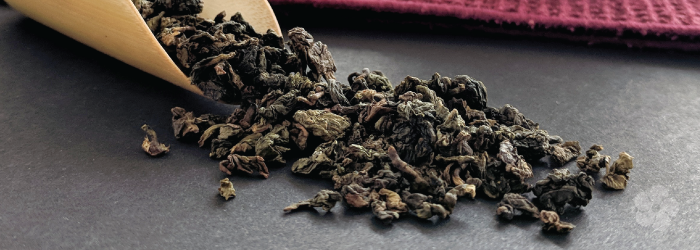
rolled leaf oolong teas made from the Tieguanyin variety are often called 'monkey picked'.
Many tea merchants will implore that while ‘Monkey Picked’ is now applied to lower grades, their own tea bearing that name is, in fact, authentically picked by monkeys. Even among aficionados, many self-proclaimed experts will insist that while most “Monkey Picked” teas are simply cashing in on the marketing opportunity, there is one “true” monkey picked tea, where innovative local farmers have indeed successfully trained monkeys to help them harvest tea plants that are difficult to access. Ironically, the lack of photo proof or common knowledge of these practices only heightens the sense of obscurity and value for these “authentic” claims. It could just be monkey business.
Part of the reason for this story’s persistence is its closeness  to truth. Indeed, monkeys are trained to harvest other crops like coconuts, and have certainly proven they have the intelligence and dexterity for these kinds of tasks. For those of us who don’t have extensive experience with training monkeys or picking tea, this seems like a fairly believable solution to an established problem.
Delicate young tea leaves are the most prized, but must be handled carefully during harvesting
But unlike coconuts, which can be handled roughly and dropped from great heights without damage, tea leaves are delicate and fragile before they are wilted for processing. Tea leaves must be carefully handled to avoid bruising or breaking before they arrive at the processing centre, and all tea harvesters must be able to differentiate and carefully select the proper leaves for the specific tea’s plucking standard, which often varies with the season.
These stringent standards, enforced most strictly in the making of the highest grades, require the awareness and skill of humans with years of experience, and are unlikely to be met by monkeys who are simultaneously scaling steep and dangerous cliffs. Similarly, it is unlikely that lower grades would be picked by monkeys, since the same function can be filled by more efficient machines with fewer maintenance costs.
At any rate, in all our years travelling to tea farms in China, we’ve only caught sight of the slackers - we’ve never seen a single monkey picking tea leaves.

Monday, 4 February 2019

Me and Shorty; The Falling Out

On the run up towards Christmas in my childhood years, say up to the age of about 12, we would collect and hoard the glass jars from which the last bits of peanut butter, lemon curd spread and boiled sweets had been scraped, licked, rinsed and chiselled out. 

These would be put aside in readiness for a session of gift making for our Grandparents. 

The larger and more ornate the jar the better as they would soon be carefully filled, spoonful by spoonful with bright, crystal clear and perfumed bath salts. 

I seem to remember that they were purchased in bulk from Boots The Chemist or a local discount shop, perhaps even the old Woolworth Store. 

In quantity and quality they made the perfect pocket money budget present. 

After a bit of decoration around the jars you would be hard pressed to find anything more lovingly crafted and personalised. 

What's more they seemed to be really appreciated by the recipients as it appears that to those of our Grandparents' generation they represented a bit of decadence, luxury and frivolity against a backdrop of the austere eras through which they had themselves grown up, between the two World Wars and in the prolonged years of rationing that followed in peacetime well into the decade in which me and my siblings were born. 

The strong smell, fine dusty residues and even a few saved for our own bath times have formed a very enduring memory. 

Well, my carefully archived memories have now been sullied somewhat by the modern drug culture reference to bath salts meaning something completely different and as far away from cute and sweet as you could possibly get. 

The term is now used for a specific group of recreational designer drugs creating a psychoactive reaction in their users. 

There have been some instances when the proper and old fashioned bath salts as found in my own childhood were used to disguise their more potent and destructive namesakes. 

Here is the science bit.

Synthetic cathinones such as mephedrone, which are chemically similar to cathinone, naturally found in the plant Catha edulis (khat), were first synthesised in the 1920s. They remained obscure until the first decade of the 21st century, when underground chemists rediscovered them and began to use them in designer drugs, as the compounds were legal in many jurisdictions. 

In 2009 and 2010 there was a significant rise in the abuse of synthetic cathinones, initially in the United Kingdom and the rest of Europe, and subsequently in the United States. 

Drugs marketed as "bath salts" first came to the attention of authorities in the US in 2010 after reports were made to US poison centres In Europe, the drugs were predominantly purchased from websites, but in the US they were mainly sold in small independent stores such as gas stations and head shops. 

In the US, this often made them easier to obtain than cigarettes and alcohol.Bath salts have also been sold online in small packets.Hundreds of other designer drugs or "legal highs" have been reported, including artificial chemicals such as synthetic cannabis and semi-synthetic substances such as methylhexaneamine. 

These drugs are primarily developed to avoid being controlled by laws against illegal drugs, thus giving them the label of designer drugs.In the US, the number of calls to poison centres concerning "bath salts" rose from 304 in 2010 to 6,138 in 2011, according to the American Association of Poison Control Centers. 

Calls related to bath salts then began to decrease; by 2015, the number had declined to 522.

Is nothing sacred?

Is it not a precious thing to conserve the recollections of an innocent childhood? 

Sunday, 3 February 2019

Stand and Deliver


The Urban Dictionary for the 21st Century

DELIVEROO: (pronounced deliver-oo). (i)ref  First sighted around 2013 in city or large urban areas as natural habitat. Now global phenomenon in 200 locations. UK population circa 15000 out of 35000 worldwide. Male or female in gender, not age specific although mainly younger generation as main participants. Nocturnal and daytime operating. Characterised by bright livery to upper torso, comprising Celeste variation of turquoise with silver piping which has fluorescent and reflective properties in direct light. Defining feature of large back mounted appendage, removeable, soft shell but bulky and carrying variable contents within foil insulated lining. Fast moving on two wheels either motor or pedal drive in built up areas and prone to be reckless amongst vehicular and pedestrian traffic. Almost invisible to the naked eye at best of times especially if means of artificial illumination has failed or is non existent. Hard working ethical basis although subject to minimum wage and difficult conditions especially during winter months. (ii) ref Frequently found in or around food establishments for brief periods and across a wide catchment area in any one district. Lifestyle factors promote a healthy existence as long as diet avoids over indulgence in fast foods. Occupational hazards include road accidents, punctures and having to cycle into a head wind or driving rain. Not a sustainable form of occupation with many attributing the activity to financial considerations or filling in time between doing other things. Health issues associated with the job include colds, influenza, back strain and saddle sores. Activists seeking legal review through British High Court over status as defined currently as self employed with no entitlement over pensions, holiday and sick pay or to those Rights enjoyed by other workers.